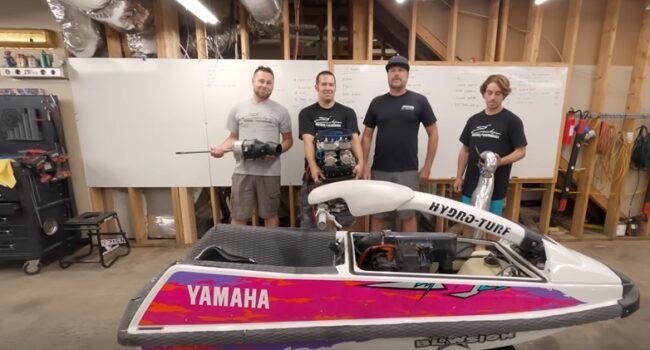
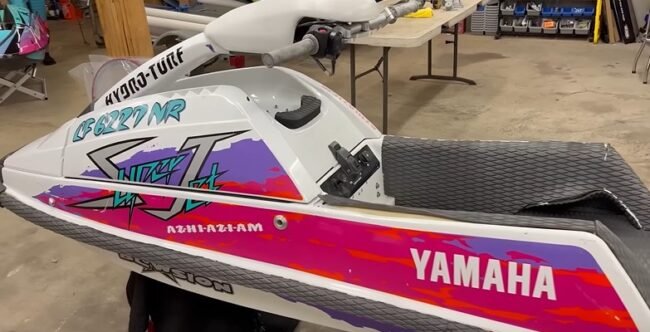
Mike Finnegan’s Garage usually features crazy project cars, cool trucks, and hopped-up boats, but he recently decided to shake things up and put out an episode featuring his classic 1994 Yamaha SuperJet.
More than a decade ago, Mike traded a 50cc Honda pit bike for the 2-stroke stand-up ski, and after working out some electrical demons and rigging up a replacement steering cable, he has ridden it hard without much more than basic maintenance.
Mike kept the 1994 2-stroke “Square nose” SuperJet basically stock with the exception of a Solas impeller, an upgraded ride plate (to reduce porpoising), and an occasional coil pack. Recently, however, the ski began to have some mechanical trouble and Mike decided it was time for a proper rebuild.
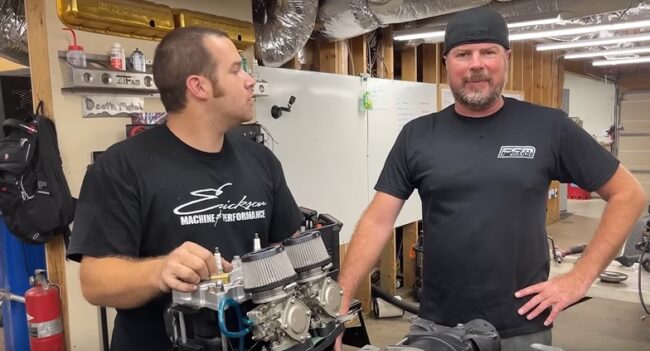
He called in Mark from Erickson Machine and Performance to turn his 28-year-old SuperJet into a bonafide hot rod. Ericson Machine focused on reliability when building out this ski, going to the newer style 701cc 62-T engine that came stock in the newer Yamaha “round noses” until they went 4-stroke.
The teardown of the ski went pretty quickly, with the guys knocking it out in just over 23 minutes. A snapped engine mount bolt ate up a ton of that time as the guys wrestled with the snapped stud. With the ski finally stripped, it was time to begin the rebuild from the jet pump forward.
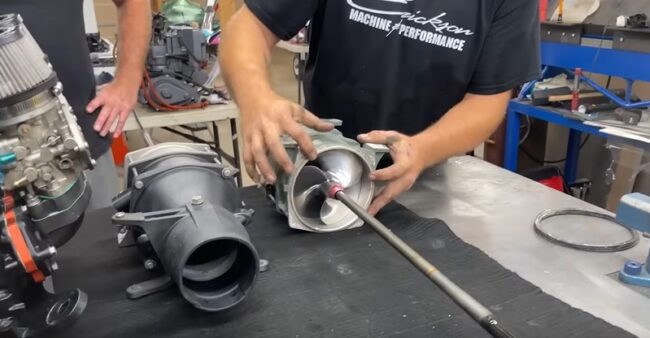
Erickson installs the jet pump first, so that the input shaft can be properly aligned with the intermediate shaft and then with the coupler on the engine. Proper alignment and shimming are critical, and Mark takes his time to do it right. The new jet pump has a bored exit nozzle, a blueprinted and ported body, and additional cooling ports.
The new Solas stator also features a full stainless-steel body which reduces the corrosion and swelling common between on the aluminum housing and stainless wear ring of the stock pump. An upgraded cooling system includes dual channels, and a Stinger valve at the rear of the craft- which will open and close to fill and dump the water box- increasing bottom end power and torque.
This build also has a polished and tuned Factory Pipe B-pipe specially formed and designed for the SuperJet, as well as custom port-work and a billet head girdle to strengthen the water jacket and head. Forged 84mm Wossner pistons and a modified stroke length will allow the improved engine to produce about 130 horsepower.
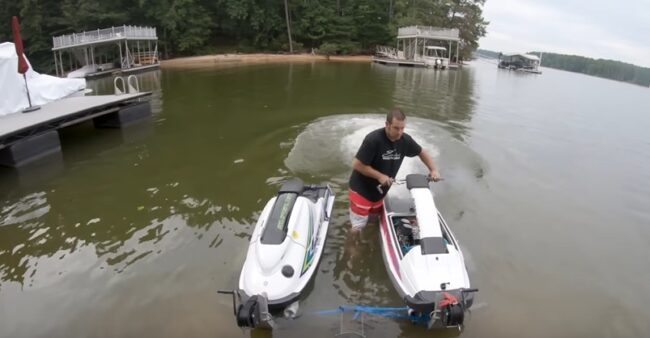
Mike and guys get the ski in the water and fire it up for the first time. After running and revving the engine for a bit, Mark does a plug chop- a critical step in tuning 2-stroke engines. After making some adjustments to the carbs and leaning out the fuel-air mixture, the ski is ready to ride!
Despite nearly 30 years of hard service, this classic 2-stroke “square nose” Yamaha SuperJet has been given a new life as a 130hp stand-up hot rod any freestyler would be thrilled to ride.
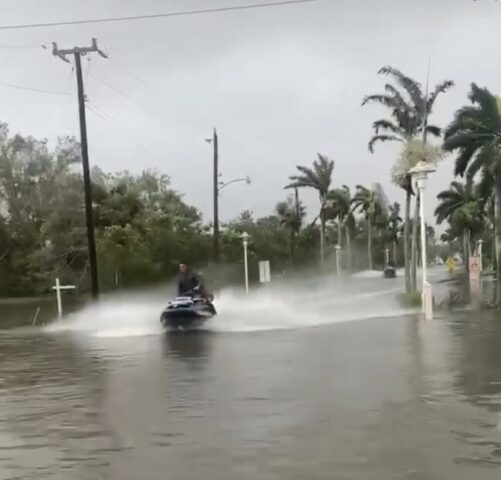
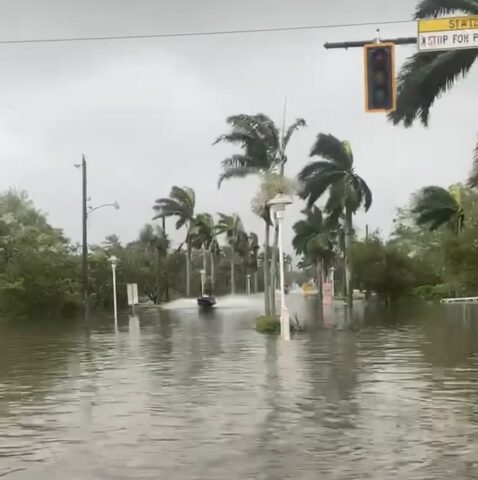
Hurricane Ian had just ripped its way through the West Coast of Florida, packing devastating winds and record levels of storm surge. Some areas of Naples encountered flooding greater than 8 feet; leaving many first responders completely immobilized.
In fact, Naples Fire-Rescue Department itself became flooded when rising waters overwhelmed the station- leaving fire trucks submerged and even causing one trucks to begin smoking.
Naples Fire-Rescue Engine 2 was en route to investigate a potential fire when the apparatus encountered high water and was unable to make it through. A video of the incident emerged on Facebook, and Watercraft Journal reached out to the Naples Fire-Rescue Department for more context.
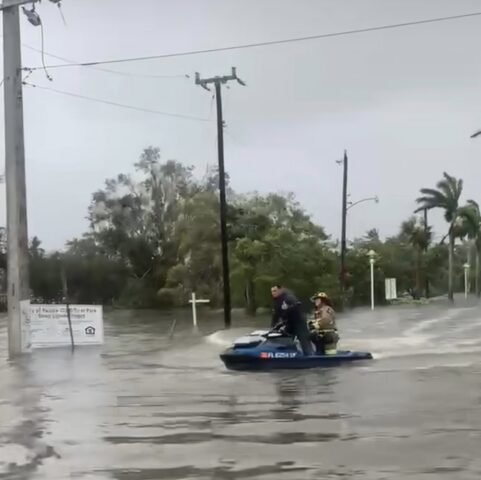
Shortly after Engine 2 became immobilized by the rising water, good Samaritans on SeaDoo PWCs approached the engine and crew and asked if they needed a ride, according to Tarin Nagel with the Naples Fire-Rescue Department.
First responders boarded the SeaDoos- fully decked out in their firefighting gear- and were transported to the scene of the emergency, where they took mitigating action.
Around the same time the Naples incident above occurred, a post appeared on Jet Rider Nation Florida describing a group of PWC owners who had mobilized in Cape Coral and Lehigh Acres, to assist in rescue and recovery efforts.
Even though PWCs often get a bad rap for creating mayhem on the water, this goes to show that lumping all PWC owners into the same category as the mischief makers is unfair. In emergencies like this, PWCs can be utilized as a critical life-saving tool; able to travel where other vehicles simply cannot.
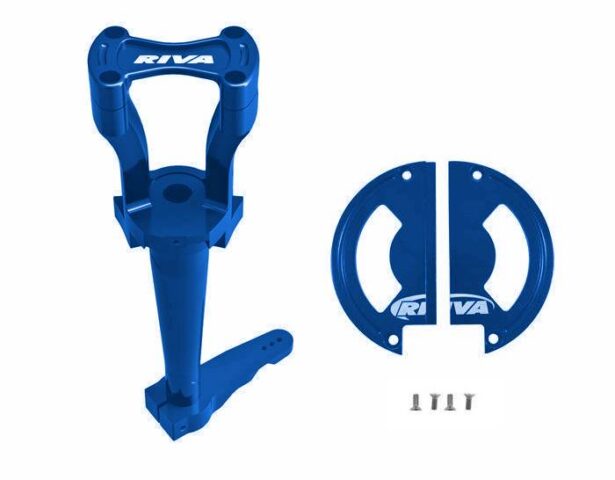
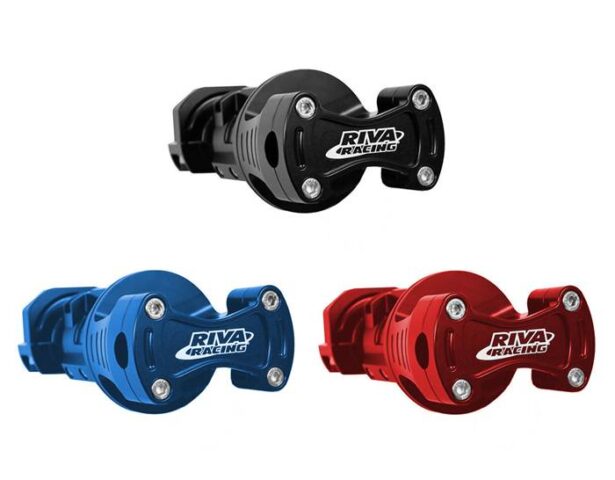
RIVA Racing has new parts in stock for Yamaha WaveRunners and Sea-Doos. Check out the new steering systems for the 2022 and newer Yamaha FX models. This is the ultimate race proven steering system, with its precision feel and comfort. It features all aluminum anodized parts to prevent corrosion. It is a much lighter and stronger unit than the stock system. It is available in black, blue, or red and retails for $729.95.
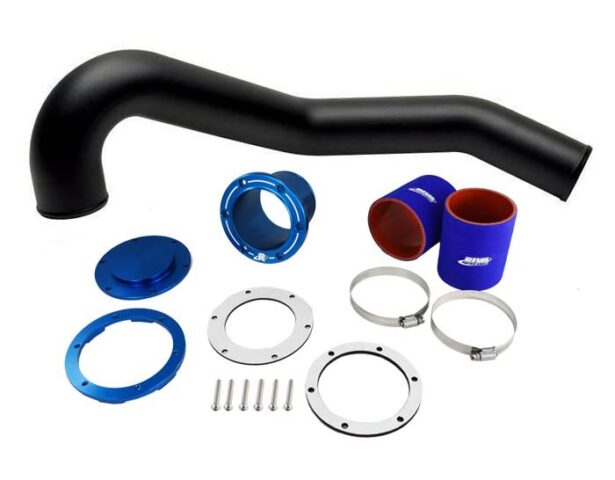
If you’re in the market for a new exhaust kit, RIVA has them for the 2015 and up Yamaha GP1800 and VXR/VXS. They also have them for the 2019 and up Yamaha FX. The kits are powder coated and work to reduce back pressure and restriction. They come with everything you need to give your WaveRunner an extra boost in performance.
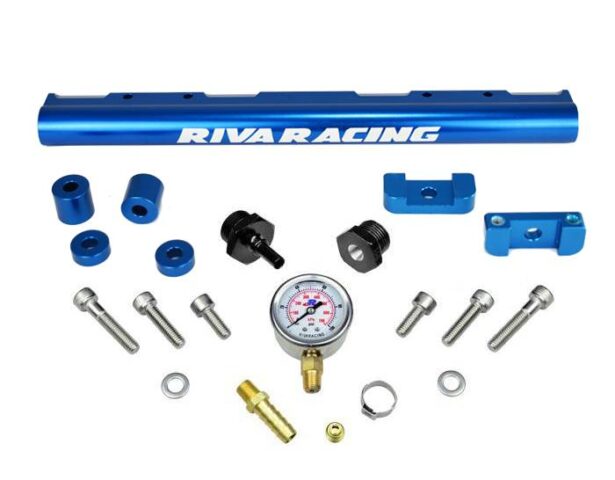
The RIVA Yamaha 1.8L High Flow Billet Fuel is an excellent choice for upgrading your fuel system for your modified jet ski. It can support 500+hp applications with its increased flow capabilities.
RIVA Racing also has the RIVA Sea-Doo High Flow Billet Fuel Rail for modded Sea-Doo’s. It is built to handle the increased horsepower that a supercharged or turbocharged engine delivers. Steering systems are in stock for the 2018 and later RXT/GTX and the 2021 and up RXP 300. These steering systems are built for racing hard. They are constructed of aircraft grade aluminum tubing for maximum strength and rigidity. They are available in black, blue, or red anodize. Check out the RIVA website for more high-quality parts to get your jet ski ready for the next race!
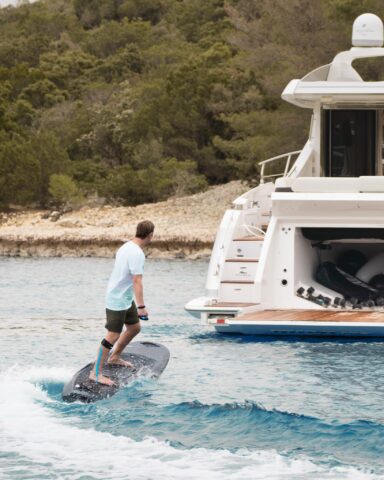
Check it out, Radinn will be showing off their electric jetboards at the 2022 Fort Lauderdale International Boat Show (FLIBS) October 26th-30th. The show is happening at the Broward County Convention Center and the Radinn crew will be in Booth C9. They are the world’s leading jetboard company and their complete line of jetboards will be on display at FLIBS.
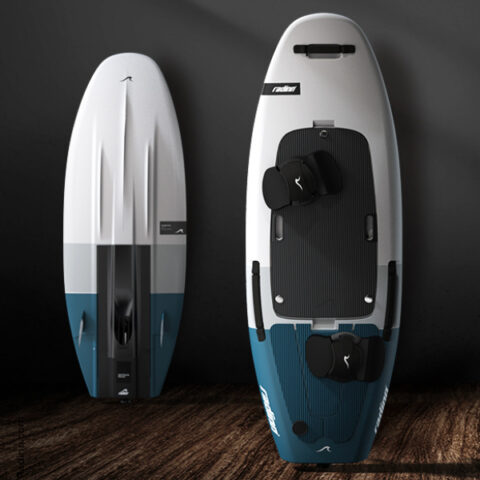
Here is the lineup and a little bit about the boards: The Carve Phantom and Carve Tarifa known for their carving abilities and responsiveness are their top-of-the-line boards. The Carve is the ultimate in maneuverability and the board is for the rider who wants to perform at another level.
The Freeride Element and Freeride Rebel are all around easy-to-use boards due their added stability. This is the perfect ride for the beginner. It can also cut through the chop like a champ.
The X-Sport is the board to take on those missions to discover new bodies of water. This board can take a beating with its high impact hull, which makes it great for water with debris, stumps, or other hazards that could damage an ordinary hull.
Lay your eyes and hands on the complete collection of Radinn Jetboards at The Fort Lauderdale International Boat Show. Head down south and chat up with the Radinn crew at the show. They’ll be stoked to meet you and tell you all about the boards on offer.
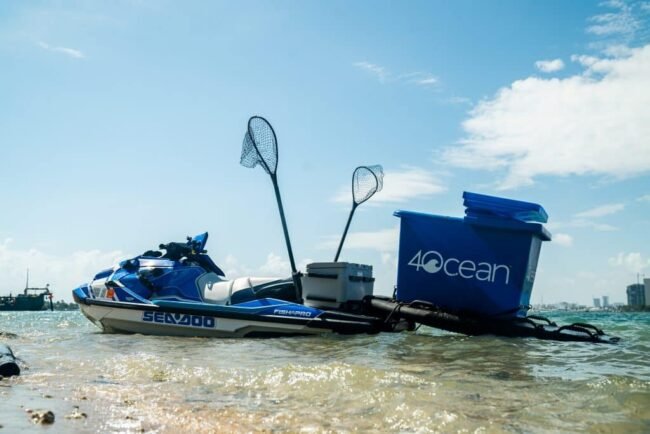
Sea-Doo has partnered with global organization, 4Ocean, a company committed to ridding the world’s oceans of plastic trash. 4Ocean was founded by two surfers out of Florida who traveled to Bali and saw the impact that plastic trash had on marine life and coastal communities.
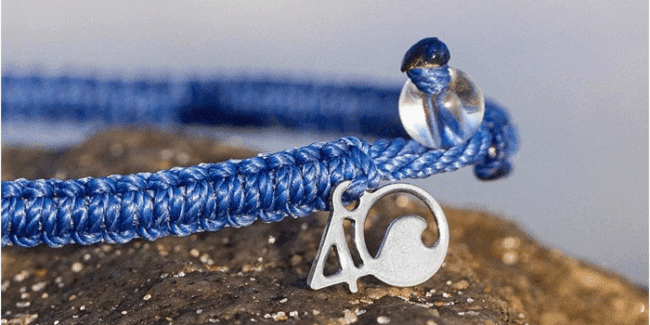
The company is a Public Benefit Corporation, which enables thing to bring in businesses to help fund their global cleanup operations. They began selling bracelets in the beginning to help fund their cleanups and to serve as a reminder of their mission. Millions of pounds of trash later, and they’re still selling bracelets. Sea-Doo signed on to deliver on the ‘One Pound Promise’. What this means is that for every product sold, order placed, client signed, or service rendered a pound of trash will be recovered.
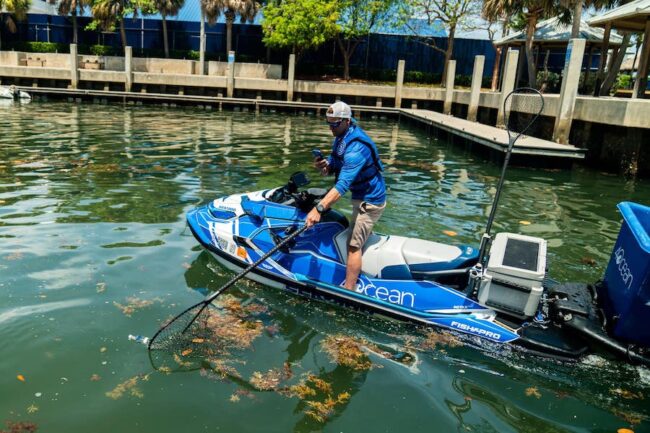
Also with the Sea-Doo partnership, 4Ocean crews now have several Sea-Doo FishPro’s outfitted specifically for cleanup by 4Ocean in Florida. The gear includes big blue trash bins attached to the stern with the 4Ocean logo and nets for trash retrieval. FishPro’s make excellent tools for cleanup missions with their huge storage capabilities and iDF system.
The skis will give the teams access to gnarly areas on the water that can’t be reached by boat. This partnership is great for Sea-Doo and further solidifies their commitment to the environment. Check it out and get onboard with Sea-Doo and 4Ocean.
The 2022 Yamaha End of Sales Event started October 1st and ends December 31st. It’s a good time to purchase that WaveRunner you’ve been dreaming about. Prices are most likely going up for next year due ongoing supply chain issues. If you can swing it and can find a WaveRunner, take advantage of the sale. They have several offers, and the better qualified you are, the better the interest rate.
Unfortunately, the Interest rates are higher than usual during the End of Season Sales Event because of the Feds trying to fight inflation by raising the rates. We’re not trying to be downers, just making note of the current situation. There are still some decent interest rates on the WaveRunners.
An offer of 5.49% APR for 60 months is available for new 2017-2023 Yamaha WaveRunners on approved purchased using the Yamaha Credit Card. You can take advantage of 4.99% APR for 36 months on new 2017-2023 WaveRunners using the Yamaha Credit Card. The last deal is 5.99% APR for 96 months on the purchase of two Yamaha WaveRunners.
This offer is only available to well qualified tier 1 credit customers who finance through Yamaha Financial Services. All the offers require you to take delivery from retail stock by 12.31.2022. Check out the Yamaha WaveRunner site for all the details on the offers. While you’re there, build and price your new watercraft and fill out the prequalification form. See you on the water!
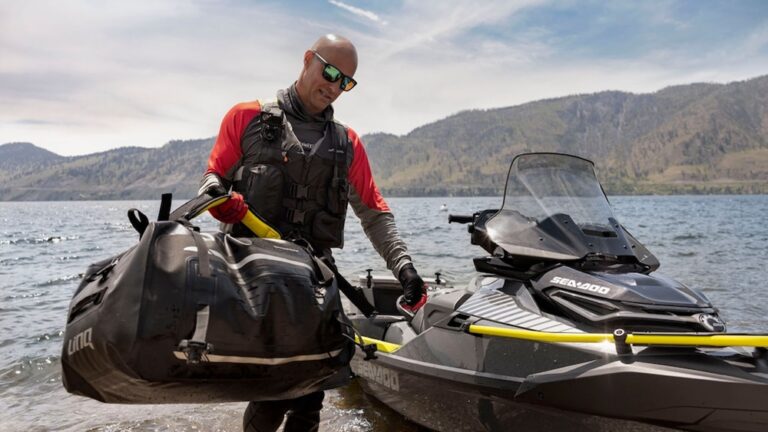
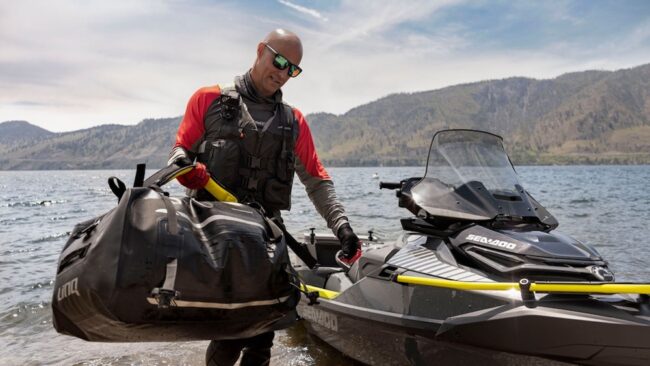
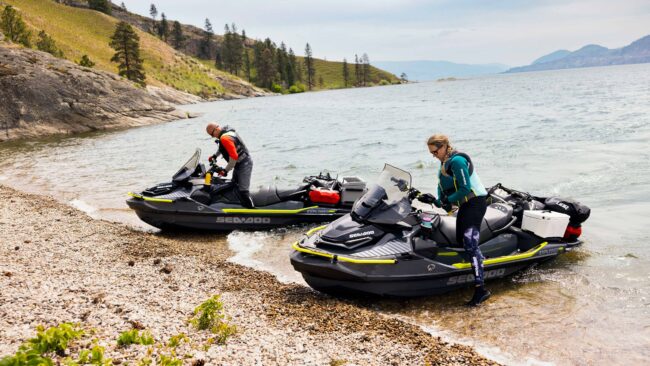
Sea-Doo knows how to build skis geared toward specific on the water activities, like the FishPro models and Wake models. They’ve done it again with the Explorer Pro 170. This jet ski is a compact powerhouse made to get you into extremely hard to reach areas and built for the ones like us who like to disappear into the wilderness for a few days.
It has Sea-Doo’s super stable ST3 hull, made for those long distance open-water rides when you really want to get out there. The Explorer is made for the adventurer and all his or her gear. We like the adjustable handlebars too. Set them low for when you want to sit down and cruise and raise them for when you want to stand up and ride.
Ride in comfort with the extra padding on the Explorer Touring seat, knee pads, and get some protection from the spray from the industry’s first touring windshield while looking for that little sandbar with the cool camping spot. With this PWC, you can carry all your camping gear and more with the rear deck extension if the 100 liters of built-in storage isn’t enough.
The Explorer Pro 170 comes with an excellent tech package, which includes a 7.8-inch color display, with several built-in features for connecting devices and accessing mobile apps. Optional upgrades include a Garmin Fish Finder and chart plotter and 100 watts of audio.
The Sea-Doo Explorer Pro is powered by a powerful Rotax 1630 AC-170 naturally aspirated engine. This machine can get you to those secret spots and the 2023 model is now available for pre-order. It has a base price of $16,799 plus all the extra fees and more if you opt for extra features.
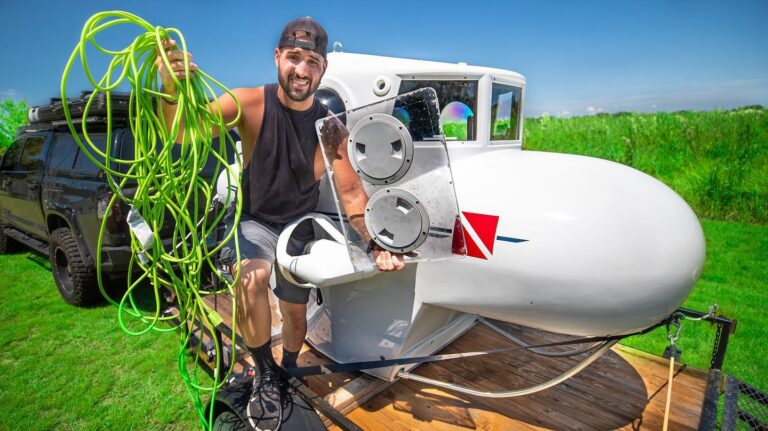
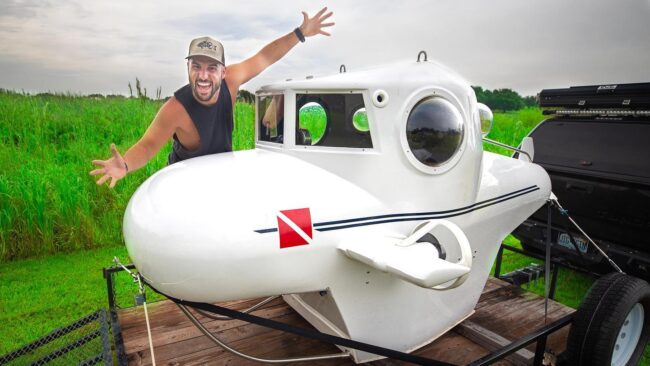
This is cool. Jordan took a risk and bought a 1998 personal submarine on August 22,2022. The submarine had been housed on a yacht and in need of restoration. Jordan was willing to go the distance and get it done. He has grand plans for the submarine, like being the only vlogging channel on YouTube capturing underwater footage from a submarine. Nearly two months later and after a lot of restoration work, he’s on his way to his dream of creating new content.
The Nautical Bros team rewired, rebuilt, and redid the plumbing to get the tiny white submarine ready for the big day. Expectations were low for this run. Jordan was hoping it didn’t sink like a rock. The first run didn’t go so well, so back to the shop it went. They removed all the lead weights, added different weight, and pulled and refilled the dive tanks to get it ready for another water test.
For the final test, a safety diver was there in case something went awry in the water. The test went well, and Jordan was ecstatic. The Nautical Bros got it done and having the fully restored submarine has completely changed Jordans YouTube channel. We can’t wait to see what new and cool content he captures from his tiny white sub! Check out the water testing video for all the details.
Easily one of the best rides I had been on was exploring Pamlico Sound and Cape Hatteras. That was waaay back in 2008, so the fog of memory has glossed over the unrelenting beating we took riding from Cedar Point to Ocracoke Island. I can certainly recall encountering brutal conditions as we passed the inlet, but the sting of saltwater in my eyes and aching in my joints has all but vanished over the years.
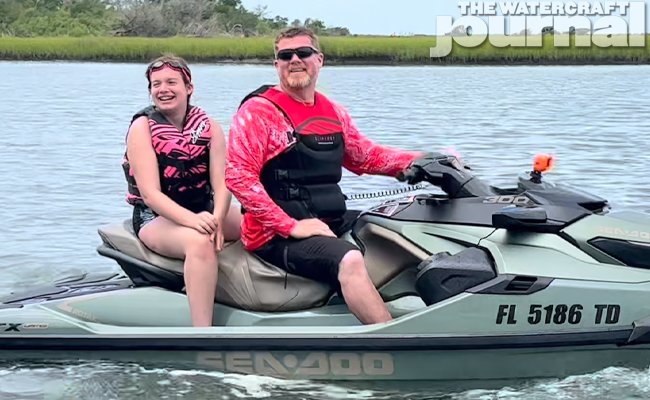
So when the opportunity to return to North Carolina’s Intracoastal Waterway arose, I couldn’t say no. Unlike the first trip, which was planned and paid for by Kawasaki’s media group, this week would be at our own leisure. This was to be a family trip. While the wife and two youngest kids were gonna ride on Uncle Ted’s 21-foot center console, my oldest would join me on the Sea-Doo.
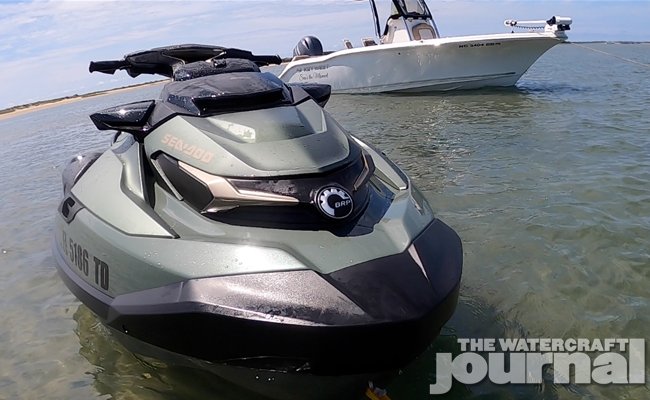
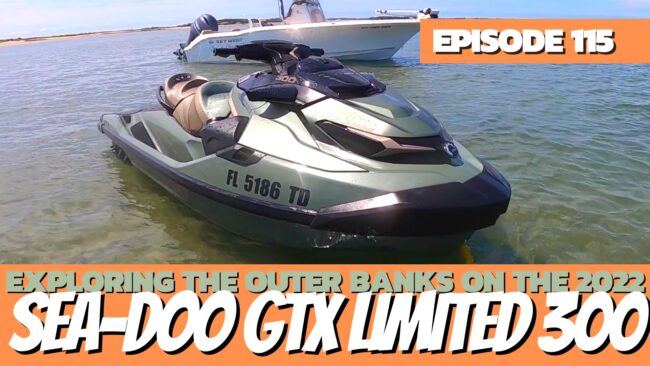
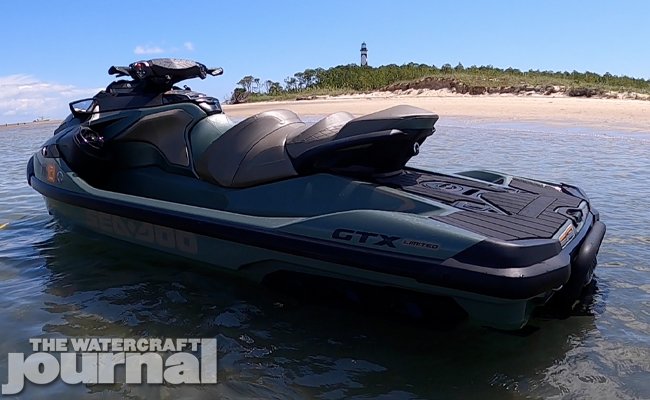
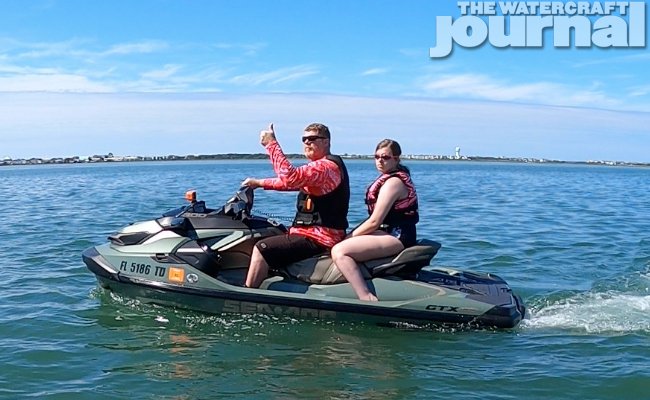
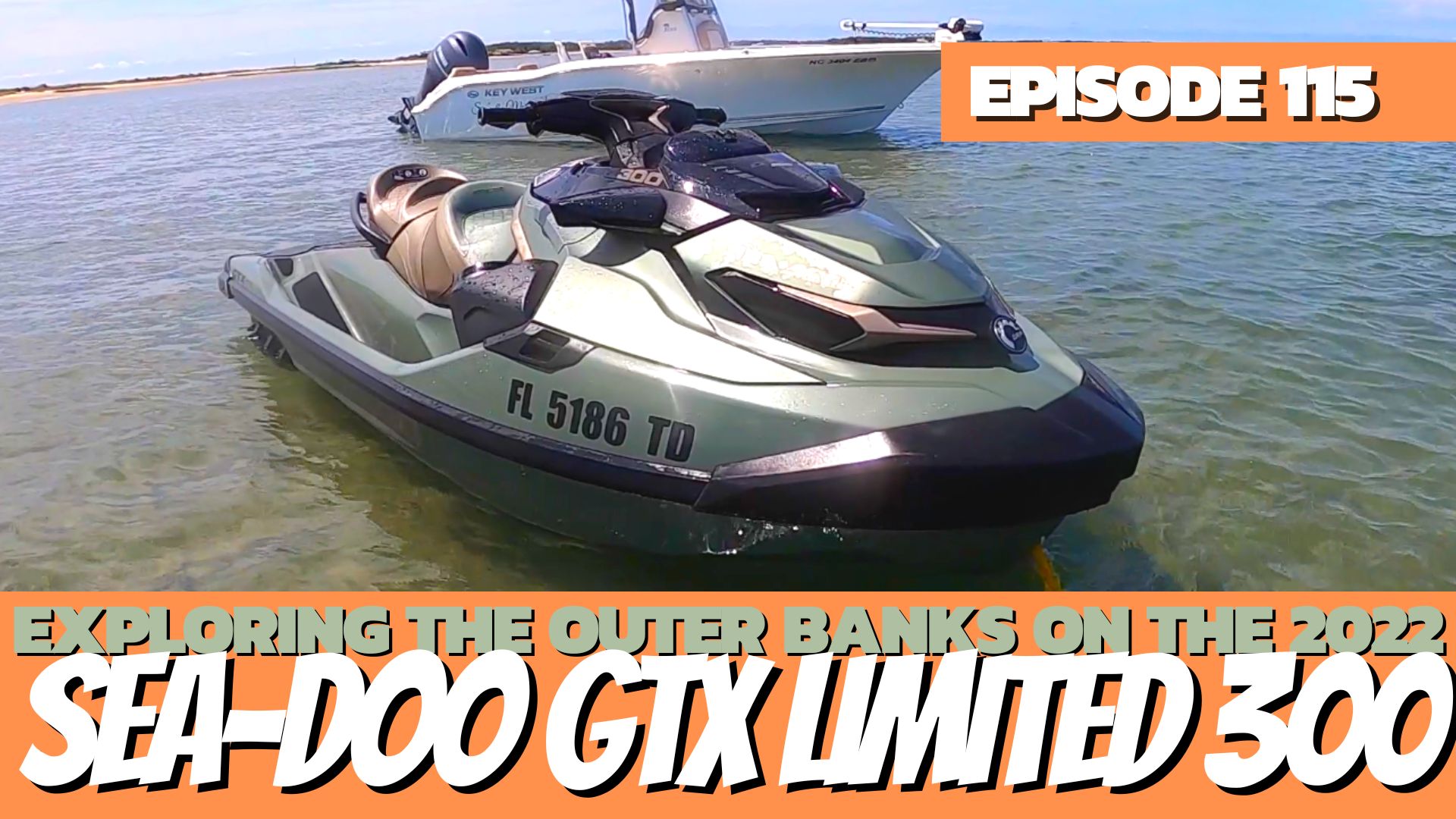
I had picked up a 2022 Sea-Doo GTX Limited 300 (opted in premium Sage Green Metallic – for an added $300) only two weeks earlier and frankly, had only been out on it twice before leaving; apart from the standard-equipped Tech Package, everything else about it was old hat. Four years of testing and loaners has provided me plenty of seat time with the platform and all of its ins and outs.
The GTX in its current form was first introduced as a 2018 model. It’s what BRP calls its “ST3” platform and marries several unique attributes together to make a very unusual machine. Prior to launching the new design, Sea-Doo had its Fish Pro ready to release the next model year, so certain characteristics needed to be baked into the crust; namely the utmost in watercraft stability at static and low speeds for fishing.
Equally, the ST3 needed to accommodate the Wake Pro models, so a large rear platform with an integrated LinQ accessory system and ski pylon mount was designed, as well as deep, open footwells (again for the Fish Pro). The traditional bow storage was relocated to a large 25.3-gallon center storage tub, accessible from a seated position. Lastly, as it would serve the RXT-X, the sporty ErgoLock seat from the RXP-X was adapted as well.
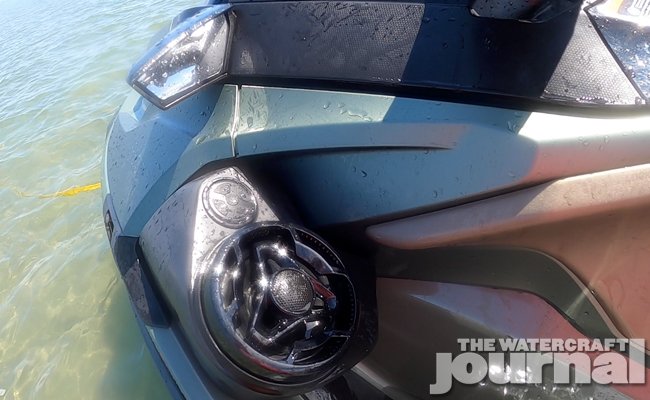
Introduced in 2022, the aforementioned Tech Package equips the GTX Limited 300 with a full-color 7.8-inch display, chocked full of smart phone integration. Synced via Bluetooth, USB and the BRP GO! smartphone app, riders can play music, monitor the weather, and use GPS navigation. At each flank is a 50W waterproof speaker (100W total) that integrates the BRP Bluetooth Premium Audio System to your device.
Of course, beneath the two-tone, stitched-and-piped seat is the 1630 ACE 3-cylinder four-stroke producing 300-horsepower at just over 8,000rpm – the same powerplant that powers the sporty RXT-X 300 and race-ready RXP-X 300. Finally, the GTX’s $18,299 MSRP also includes the center storage bin organizer mesh net divider, padded knee coves, and all-weather PWC cover totaling out the Limited package.
We set up camp in Cape Carteret, just inland from Emerald Isle. After visiting the historic Fort Macon pre-Civil War fort the day before, we set in at Beaufort and journeyed past the US Coast Guard Sector Field Office before carrying on beyond the inlet, tracing the shoreline of Shackleford Banks. The Beaufort Inlet feeds the Back Sound, which we discovered was an undulating labyrinth of ever-changing shoals and sandbars that change with the ebb and flow of the tide.
At no time was I more grateful for the onboard depth sounder continually chiming as the sea floor rose to meet our hull. Equipped with this in-dash feature and a far more shallow draft than the center console boat, we let the Sea-Doo lead the path forward. Channel markers are regularly relocated by the Coast Guard to give boaters the deepest route through the sound, which at times, was less than 9-feet deep.
We arrived at Cape Lookout, the outward-most tip of a J-hooked island made famous by pirates Edward “Blackbeard” Teach, Stede “Royal James” Bonnet and Anne Bonny. The cape is known mainly for its iconic black-and-white checkered lighthouse, earning it its name. We avoided some high-rising shoals and anchored over 50 yards from shore. The younger kids dug for shells as we prepared sandwiches and cooled down with some cold drinks.
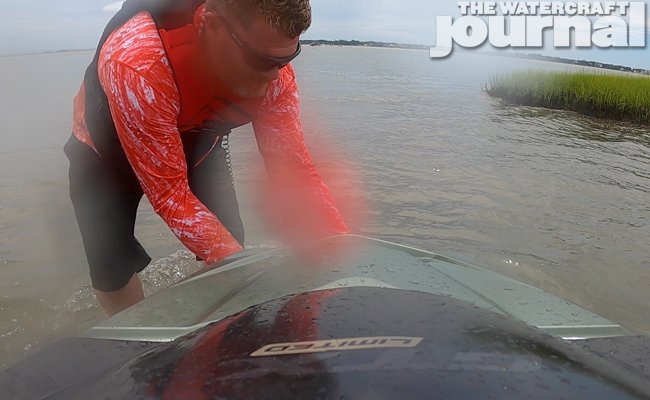
I had looped the end of my Sanddocker anchor to the GTX’s bow eye and watched as the changing (and quickly receding) tide pulled the Sea-Doo opposite of where we anchored. Concerned, I hustled from shore and began dragging the ski into deeper water. The tide was quickly going out and unless we wanted to camp over night, we needed to get moving, so we collapsed the EZ-Up and began loading up the boat.
Shackleford – like many of the outer banks – are home to wild native horses. Believed to be descendants of abandoned Spanish horses left to graze and populate the Carolina coastline, these horses crossed over on long-eroded isthmuses and remain on these grassy barrier islands. Unfazed by gawking spectators, these horses saunter up to the shoreline to nibble on lush salt grass and bullrush.
From Cape Lookout, we rode the deepest part of the channel to Hawkers Island. It was here where boat traffic picked up, and together with the afternoon’s Atlantic gusts and outgoing tide, the GTX’s hull began acting up. Despite Sea-Doo’s claims, the ST3 is not a “Deep-V” hull nor a superior offshore/rough water design. In reality, it’s quite the dramatic opposite.
What deceives most of the uninitiated as it being a “Deep-V” hull is the pronounced prow. At midships, the ST3 is demonstrably flat, smoothing out to a single-digit deadrise, giving the hull it’s characteristic stability at static-to-slow speeds. The smooth bottom attributes to the ST3’s top speed numbers, but that is in purely glassy conditions.
In mild chop or even in tracking through the wakes of other watercraft, the ST3 wanders unpredictably. In larger sea state conditions and/or elevated speeds, this bow hunting can become precarious to the novice rider – as it requires a tremendous amount of rider input (steering) to keep it tracking true.
Over time, I’ve come to find the ST3 is best suited for flat-water conditions at best. Even professional racers have abandoned the hull for the more manageable T3R hull of the RXP-X. But as noted, it’s not all bad. The ST3 is tremendously stable at slow speeds and provides an impeccably dry ride.
This is due to the bow’s shape that fans into deep, concave coves. By directing its forward wake outward in an unfurling arc, it makes for a far drier ride than a true Deep-V hull, which splits and sprays its wake upward. At low speeds, the ST3’s bow creates a roiling cushion that softens its ride in No Wake Zones.
So again to recap: the Sea-Doo sprays its wake out, while others spray up. It’s that simple.
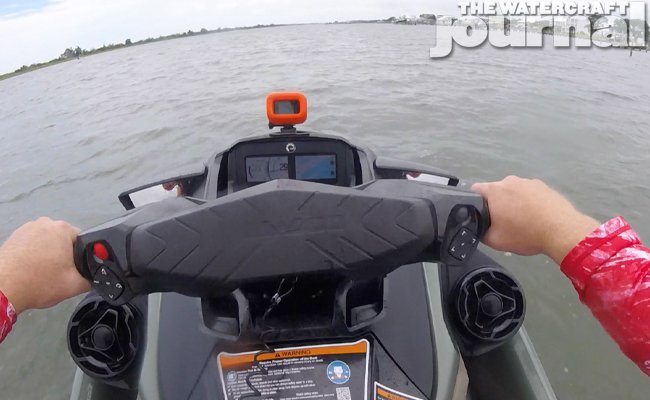
Of course, the biggest appeal of the GTX and all ST3-based Sea-Doos is the deck design. The Sea-Doo sports a low-slung, handsome shape that is angular as it is masculine. The 5-way adjustable tilt steering is seemingly perfectly placed for most riders of any height and takes the 7.8-inch digital dashboard with it as it pivots up and down for maximum visibility.
And the GTX features both Sea-Doo’s pioneering Intelligent Brake & Reverse system as well as its Intelligent Debris Free system, which electronically reverses the thrust of the impeller, surging a pulse of thrust forward to purge the intake grate of any debris clogging the intake grate – like grass or seaweed.
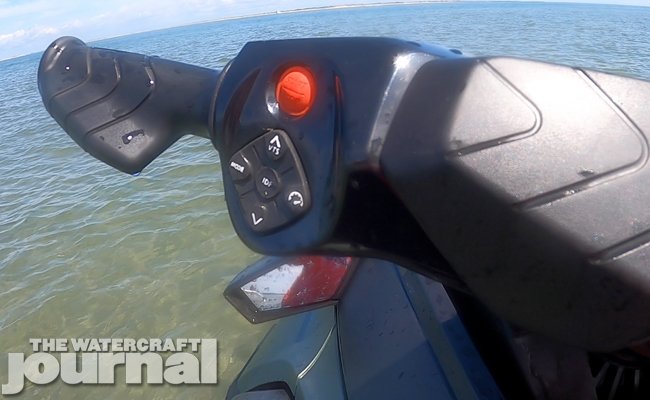
The handlebars aren’t set too wide, with large, easy-to-navigate buttons that remain some of the most responsive in the industry. The winged “palm rest” handgrips support the wrist to reduce the fatigue felt by riders after a long day on the water. Navigating the pages of the Sea-Doo’s split screen dashboard is limited while at speed, but other functions like changing dashboard background colors and tracking fuel consumption and trip hours is a snap.
Unfortunately, the premier functions found only with the Tech Package and available through the BRP GO! app are excruciatingly frustrating – particularly for those less tech savvy. The process of syncing one’s smartphone to the GTX requires logging a new profile into the dashboard. Then, it must be synced via Bluetooth through your phone’s Bluetooth settings page. Once completed, the Sea-Doo will pair with your phone.
Yet, that is solely for using the sound system separate of the Tech Package, which will not allow you to control tracks and volume through the handlebar toggles. If you choose to control your playlist through the dash and handlebar controls, the phone must be continually tethered through an approved USB cord (that is, if you have an Apple iPhone) with the BRP GO! app left “open”.
It will automatically sign out if the phone goes into “Driving” mode or if the cord wiggles enough to break the link. Moreover, the BRP GO! app requires a solid data signal or too, will automatically sign out; and needless to say, in many locations outside of highly populated areas, such a usable signal of any magnitude is nowhere to be found. This lack of signal also will keep you from accessing your music library if its stored on the cloud, so make sure you’ve got a song list downloaded to your phone if you simply cannot enjoy the outdoors without added stimulation.
The glove box is another pinch point. The glove box cannot accommodate most modern full-sized phones – particularly larger Androids. With the BRP GO! app requiring the phone to be plugged in to the USB port at all times, the watertight door cannot be latched, as the phone must sit atop it. This leaves your phone subject to getting wet as the glove box door doesn’t close fully with the phone outside of its waterproof pocket.
All of that not withstanding, the shining jewel of the GTX is its overall comfort. The narrowed Ergolock seat, deep saddle and low-backed bolsters are comfortable, even for a taller rider. Passengers are entreated with similar cushioning and large handrails at the rear passenger’s sides. Sadly, without a glove box of any usable size, drinks or sunscreen must be kept within the center storage bin, which cannot be accessed easily while underway.
After idling through Taylor Creek, which separates Carrot Island from Beaufort, we pulled the boat and GTX up the ramp and enjoyed the evening after a full day on the water. The next morning, we put in closer to home base and sped southwest toward Hammocks Beach and Bogue Inlet. There we played on the beach and listened to the marine base fire off artillery rounds (no joke) in the distance.
With some time to spend and plenty of super unleaded in the 18.5-gallon fuel tank, I with my 12-year-old behind me, sped off to play in the incoming Atlantic surf. We rapped the throttle and launched gleefully over the white caps. Jumping surf is a dangerous game that is discouraged by BRP per the owner’s manual, and for good cause. While we didn’t press our luck too far, we did dislodge a GoPro camera from its mount (we found it bobbing on its bright orange float seconds later thankfully).
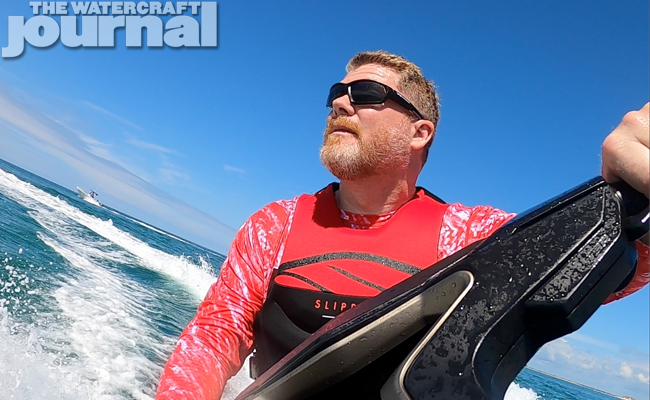
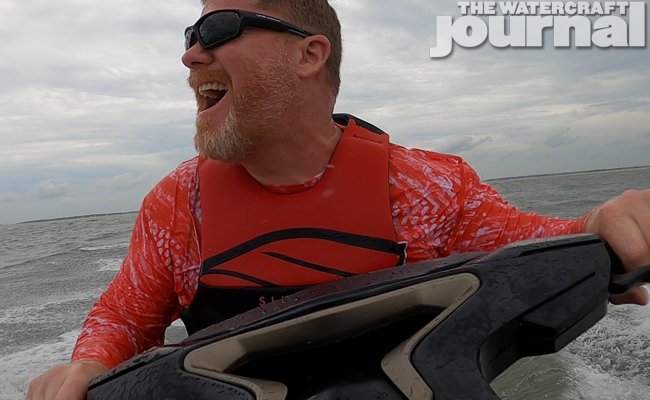
During this little jaunt in the surf, we did note one more peccadillo with the GTX Limited: the Sage Metallic paint is striking in person (particularly when the sun hits it just right); but boy, is it wholly invisible out on the open ocean. Were it not for my bright red Slippery Array Neo life vest and matching UV-blocking jersey, we would be lost to anyone searching for us.
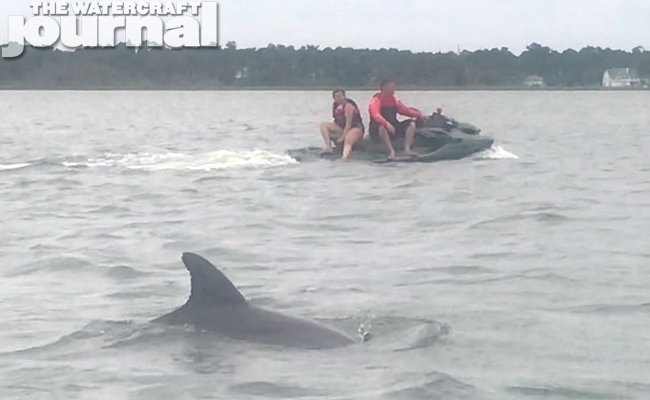
The rest of the morning was spent tracing the shoreline, carefully navigating around shallows and sandbars, and pinning the supercharged Rotax when I encountered a rare patch of glass. On our journey back to the ramp, we happened upon a pair of dolphin – a mother and a calf – swimming up the Intracoastal. It was my daughters’ first time seeing dolphins in the wild, so we stopped the engines and let the current take us with it, hoping for a closer look.
As noon bled into afternoon, we returned back to the launch ramp and drove back to camp. The Sea-Doo served us well and provided plenty of smiles, but as far as a serviceable review, I found myself struggling with a near 50/50 split of praises and criticisms:
Given the hours our loaner carried, many of its panels (as well as the speakers), had begun to loosen and audibly chattered even on mildly bumpy water. Equally, even though our time on the rough, open seas were minimal at best, I found salt deposits inside of the center storage, glove box and engine compartment.
The glove box, the need for the smartphone to be plugged in for the app to function, and the interface itself is egregious, enough for me to suggest totally avoiding the frustration altogether. Too often we become so attached to new conveniences that we wonder how we could ever have lived before without them. In this case, if you can purchase a Sea-Doo without these contrivances, do it.
Most importantly, the ST3 hull is problematic. It wanders – oftentimes erratically – in chop, teeters to one side or another when not at plane (below 35mph), and has been shown to wholly ignore steering input in tight corners – sometimes putting its pilot in precarious situations. It’s really something I cannot in good conscience omit from this review.
All that being said, there is a great deal to praise the 2022 Sea-Doo GTX Limited 300 for, and hope that we’ve adequately listed those attributes here as well. Although it’s meant to offer the consumer the utmost in luxury and premier features, the GTX Limited 300 falls just a tad short, delivering more sizzle than steak. While other models offer similar comfort with greater performance, superior rough water tracking and more storage, none do all simultaneously. And that is why the GTX Limited 300 is the top tier machine of BRP’s watercraft lineup.
You can purchase Kool PWC accessories from Greenhulk Performance. The Kool PWC racks are designed for easy installation and do not require drilling into your beloved watercraft. They come with all the necessary straps for installation. You can install them within minutes and head straight to your favorite body of water to get your ride on without breaking a sweat.
The racks are made of high-quality marine grade stainless steel and powder coated in flat black. They are made to last and able to withstand the harshest environments. Greenhulk carries a great selection of the Kool PWC Racks. A few Sea-Doo LinQ Racks are on offer.
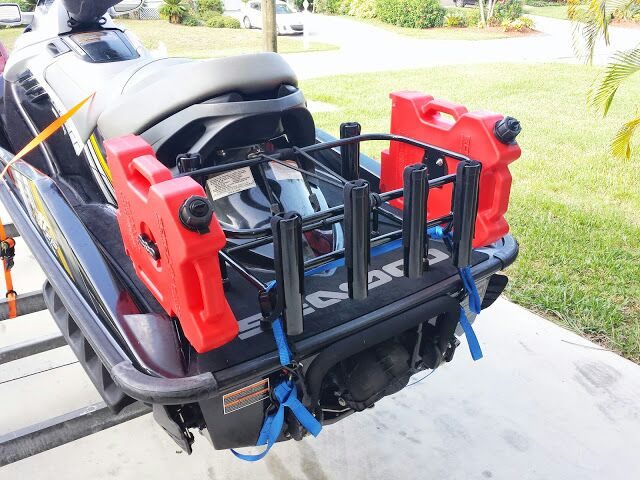
They have a nice LinQ 6-rod holder Jet Ski Fishing Rack with Gas Plates for Rotopax Fuel Tanks. That’s a great accessory for the fisherman who wants to take an extended trip. Extra fuel can make the difference from going way offshore in search of Mahi and getting back after realizing those Mahi were further out than you recall. Another LinQ Rack can carry fuel or a 35 Quart cooler.
The other Kool PWC Racks are a universal fit. You can purchase racks for 2-6 fishing rod holders with gas plates or gas brackets, racks for coolers, racks made to hold your Spearfishing gun, and a rack for trolling. A Kool PWC Fuel Rack that holds two 5-Gallson Sure Can Tanks is also available. If you only need a fuel can, the Kool PWC Sure Can 5 Gallon gas can is available. If you’re in the market for some Kool accessories for your jet ski, check out Greenhulk Performance!





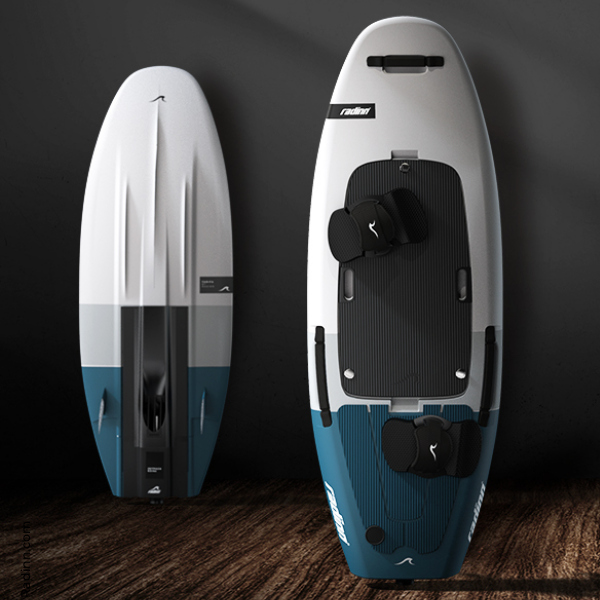
 Here is the lineup and a little bit about the boards: The Carve Phantom and Carve Tarifa known for their carving abilities and responsiveness are their top-of-the-line boards. The