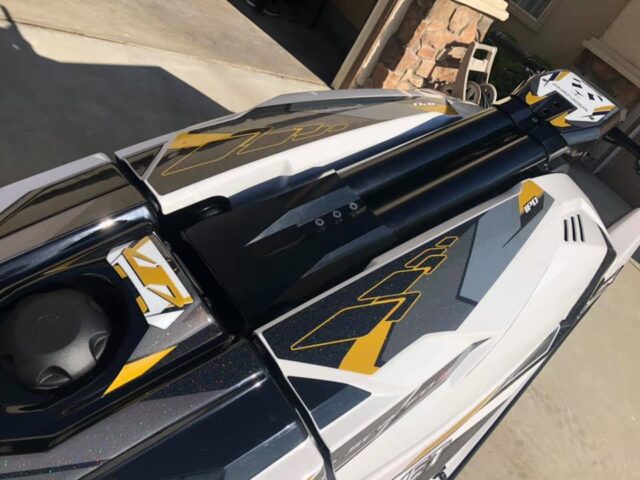
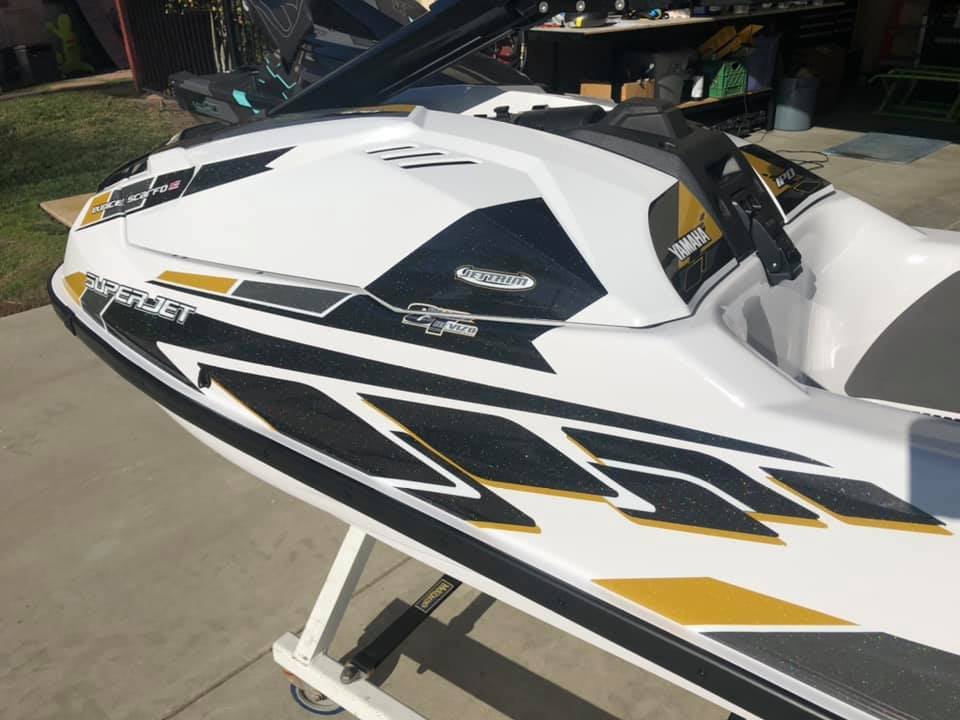
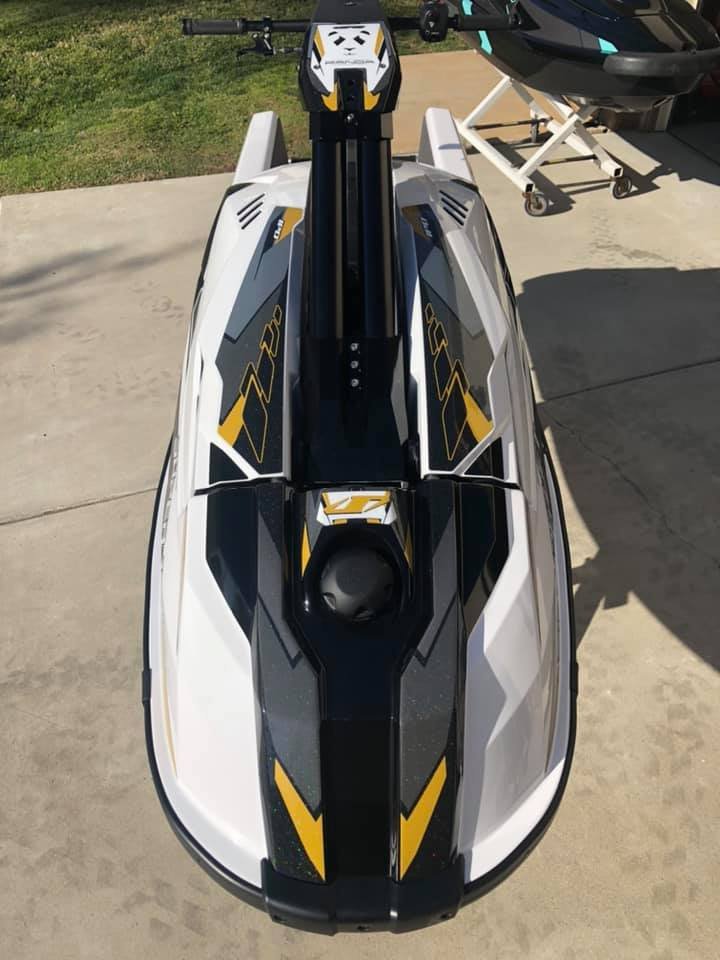
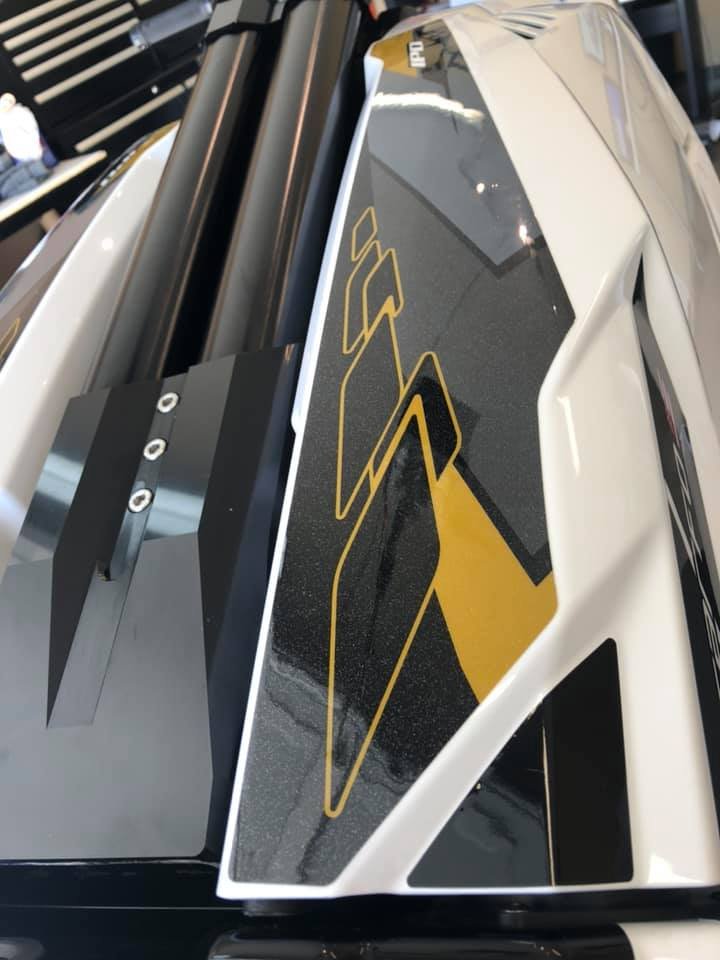
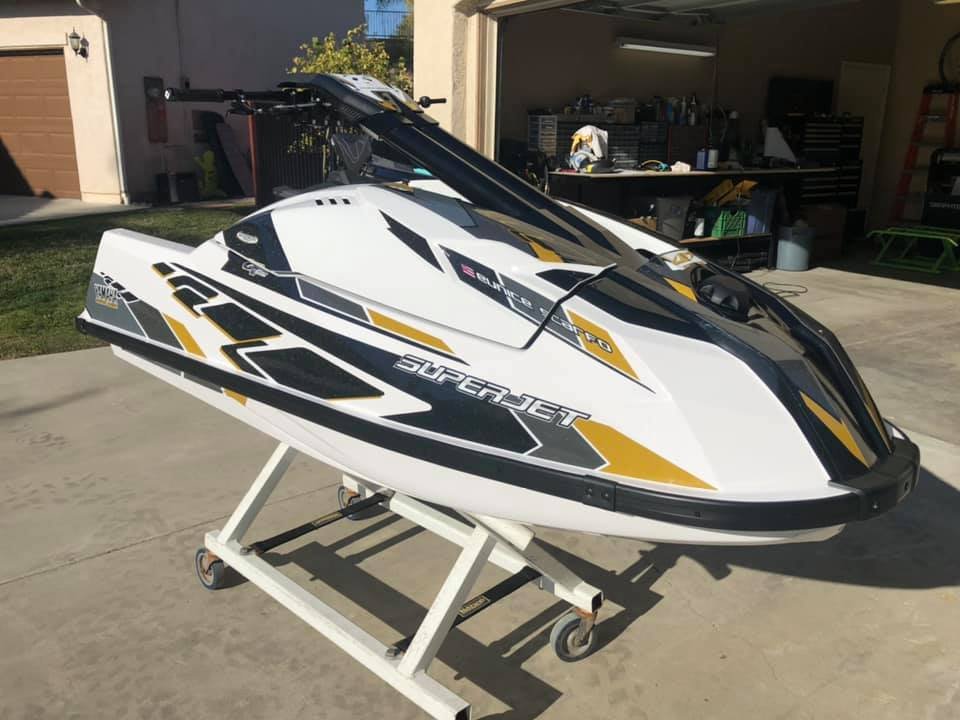
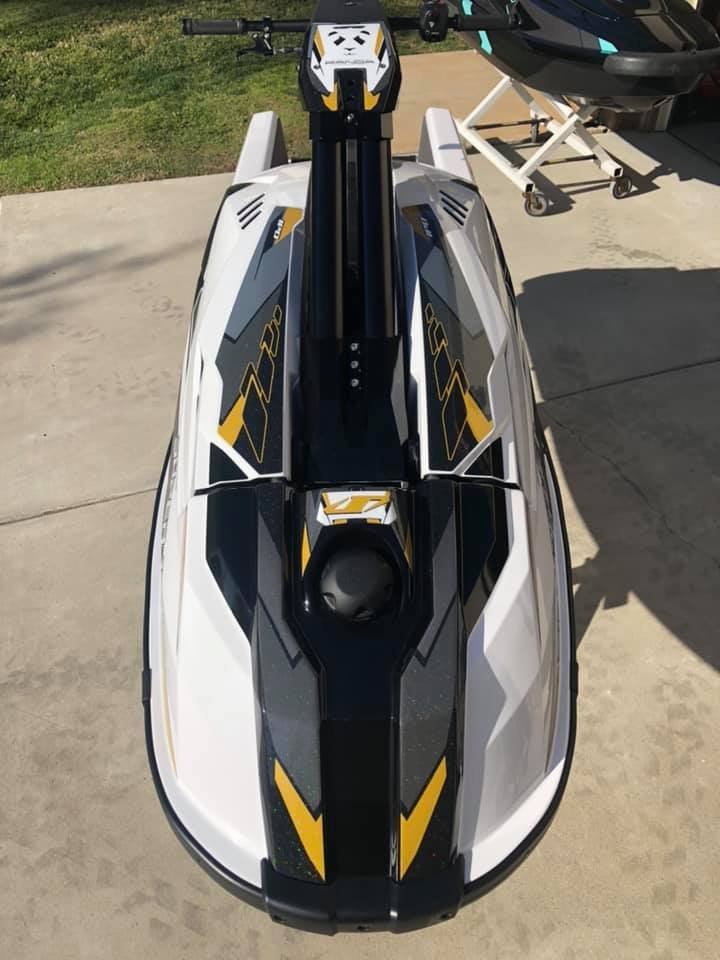
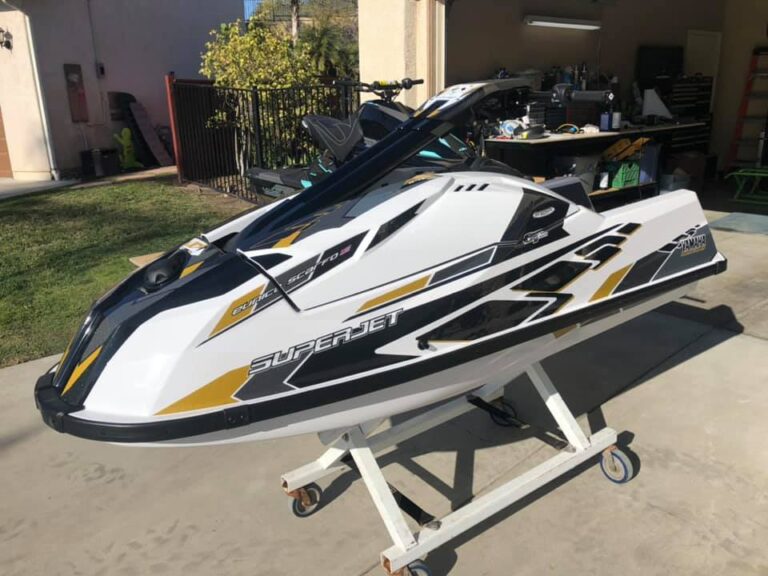
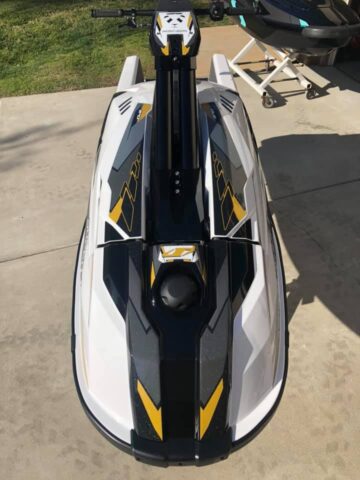
The all new all white Yamaha 4-stroke 2021 SuperJet is just begging for some color and IPD Graphics delivered with one of their new wraps. They spiced this one up with a race inspired design of black with bronze accents. The vinyl wrap is clean, and the bronze accents give it a nice pop.
The all white SuperJet provides the perfect canvas for design with its clean lines and refined design. The ski has an actual chiseled appearance, something we don’t often see. The 2021 SuperJet 4-Stroke model comes in at under $10,000 and the IPD graphics cost $339 enabling you to customize a new ski for just over $10,000.
We like this ski for its minimalist approach and the ability to make it ours with a custom graphics kit from IPD Graphics. The kits are made of a durable long-lasting vinyl enabling them to take a beating for quite some time. You don’t have to be a pro to install the kit on your new SuperJet nor do you have to be a pro to experience the challenge of riding the all-new Yamaha 4-stroke SuperJet.
Yamaha wants you to know that the latest innovation of the SuperJet is built for the next generation of stand-up riders who are looking for the next big thing. Grab yours now and give it a great looking wrap from IPD Graphics. You might become the next big thing on the water!
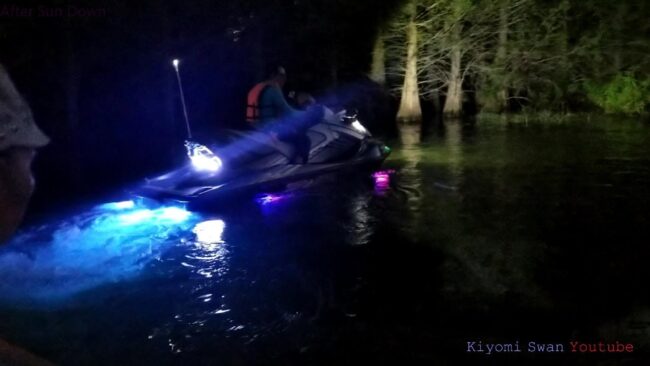
Steven in Sales presents another great article that asks the question: Can you ride a jet ski at night? The answer is “no” and we’re going to tell you why.
First of all, navigation lights are forbidden on jet skis and you will get fined by water patrol if they catch you with the lights. This has to do with the size of jet skis and the confusion that lights cause other boaters. Jet skis can make sudden moves, and this causes further confusion within the boating community at night. PWC are difficult to see during the day and impossible to see at night.
During the day, at least a rooster tail can be seen. It would be invisible at night. Also, people do stupid things on PWC (c’mon, admit it) and what’s to prevent them from doing those stupid things at night? This is a good time to bring up life jackets. Most life jackets don’t have reflectors; so if you fall off, no one can see you in the water. Moreover, it’s best not to ride your PWC in fog and when it rains. If you are riding and a freak storm pops up, get to a dock or land as quickly as possible, especially if you’re in a thunderstorm.
If you do find yourself trapped after dark on your jet ski, motor to the nearest launch or land because you aren’t visible on the water and this makes you a sitting duck. A good thing to have is a membership with one of the boat towing companies. Towing memberships are awesome and will pay for themselves with one tow and a tow isn’t cheap to get a tow! Ask us how we know. If you don’t have a membership, use your phone to call someone and then buy a membership for the next time you’re on the water. You will be glad you did.
There are some exceptions to the “do not drive your PWC at night” rule and this pertains to PWC specific to search and rescue teams, such as the Sea-Doo SAR. The SAR is available only to search and rescue teams. It is a rescue specific machine, and it is outfitted with navigation lights and it is a beast. The craft is excellent for night ops because sometimes a jet ski is needed to use for the hard-to-reach places and rescue can be required at any time. Enjoy your watercraft between sunrise and sunset because when the sun is gone, you cannot drive your jet ski.
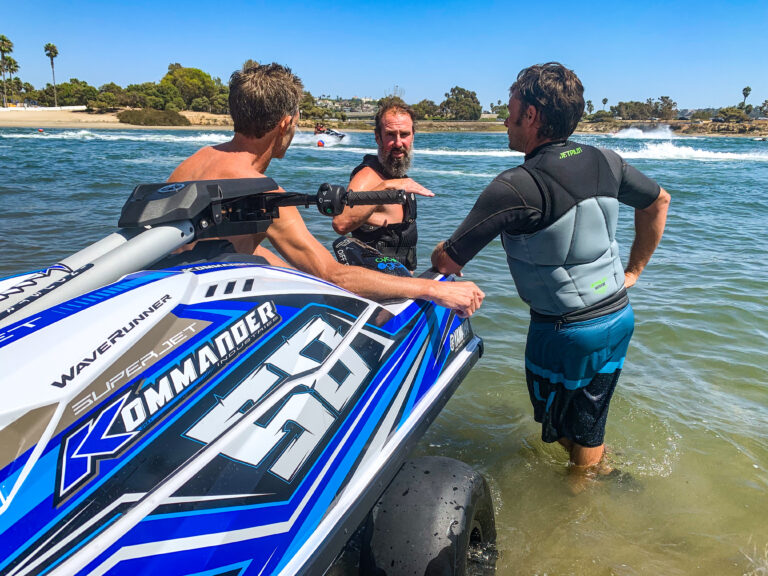
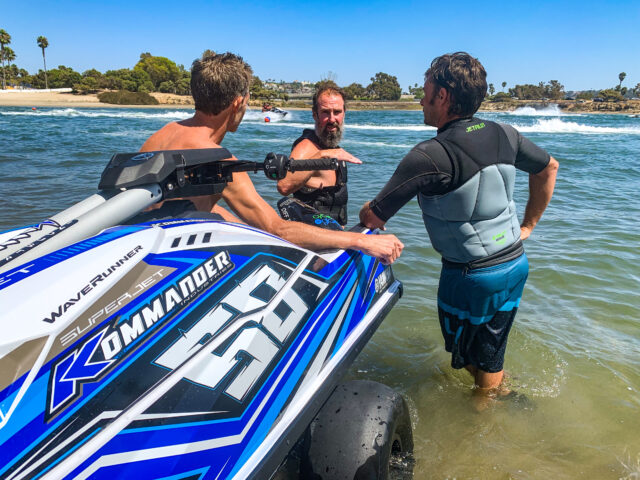
Saturday was going to be a typical day of riding for local San Diego PWC groups, but when group texts started surfacing about Dustin and Tyron Motzouris of Kommander Industries making their way to San Diego with their freshly-built 2021 SuperJet in tow, excitement heightened as the legendary duo are more known to frequent Body Beach in Lake Havasu City, AZ on the weekends to test, tune, and ride with fellow stand-up riders.
Jason Carlton, owner of JC Racing and 3D Design Concepts, got his first look at Oceanside Harbor when the Motzouris brothers unloaded their skis and took to the surf to put the SuperJet through its paces.
“Seeing the new SuperJet in person gave me a whole different perspective on the ski,” Jason mentioned. “I already liked the look of it prior to seeing it with my own eyes, however, it looks way better than I thought. The pictures didn’t do it any justice. It looked very easy to ride in the surf and overall looked like a super fun ski.”
It was a sight to see for local fishermen and tourists to watch Dustin and Tyron play in the surf aboard the SuperJet and one of their coveted SX-R 1500-powered Kommander GP1’s. Local freeriders got wind of their arrival and quickly joined in as they took to the waves and sent their skis skyward.
Dustin and Tyron then packed it up and headed south for Fiesta Island to connect with local racers and “bang buoys” with them. The offerings to ride the SuperJet were limited to a few as the island was packed with summer boaters, but they were able to get old-school legends Victor Sheldon and Larry Hoesli on it for a few laps.
“We rode the ski for 3 days straight and it didn’t foul once. It ran perfect,” Dustin mentioned. He is no stranger to saltwater, winning many championships in the surf back in the day. “It rode smooth, had plenty of torque, and didn’t feel heavy in the surf. Not once did it want to submarine. With its power-to-weight ratio, the SuperJet feels more like an SX-R 800. If it wasn’t our only ski, and if it had footholds, I would’ve barrel-rolled it!”
So where will this ski stand when it makes its way to the starting gate? The IJSBA seems to have a few ideas, including a 4-Stroke Lites class exclusively for these machines. “The ski could also be somewhat competitive in a Mod Lites class,” Dustin said. “Although the hull doesn’t perform nearly as well as the current aftermarket hulls, the new SuperJet could be improved with handling parts.” Dustin also went on to state that they have a “laundry list” of parts that they are currently working on for the ski.
Now we end with the question that is eating away at all PWC enthusiasts: How long do we have to wait to get our hands on the new SuperJet? Shipping has greatly affected many dealers and manufacturers due to heightened restrictions with COVID, and Yamaha is certainly feeling the brunt of it. But that has not stopped the thousands of watercraft aficionados that have already put down deposits and patiently waiting for that email or phone call from their local dealer. We can’t wait to see more of these on the water, and hopefully, behind the starting band!
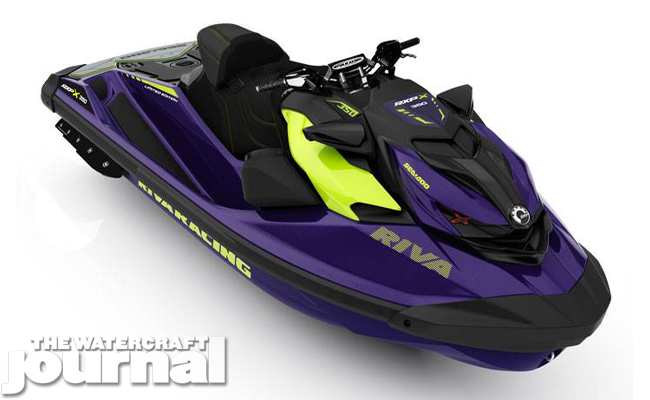
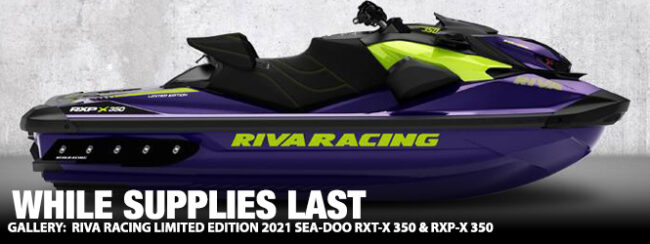
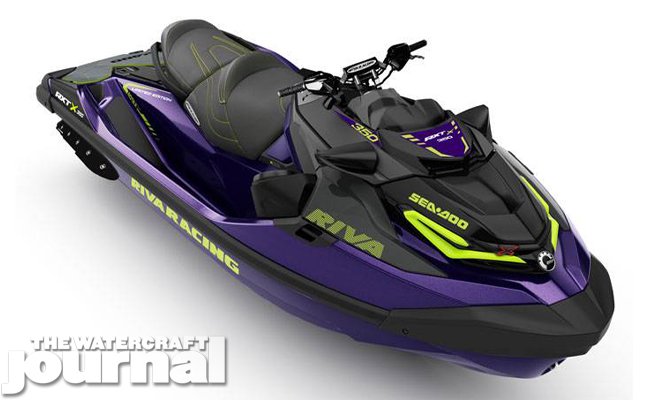
The RIVA Racing crew stayed extremely busy during these pandemic times. The crew upgraded a Sea-Doo RXT-X 350 and a Sea-Doo RXP-X 350, both done in typical RIVA Racing style-big and bold! Both machines were wrapped in head turning purple and neon yellow with a matching custom color seat cover. These machines were outfitted with the RIVA performance products perfectly matched to their respective Sea-Doo platforms. The engine cranks out a reliable 350-horsepower with a top speed of 81mph. RIVA quickly sold out of these Limited Edition Sea-Doos.
Now let’s get down to the nitty gritty of parts. Both custom models were equipped with a RIVA MaptunerX BRP License. The license enables the user to switch between performance and stock settings. A RIVA Sea-Doo 2020+ RXT/GTX 300 Power Filter in order to feed your supercharged engine that much needed steady flow of cool air and greatly improving acceleration and rpm.
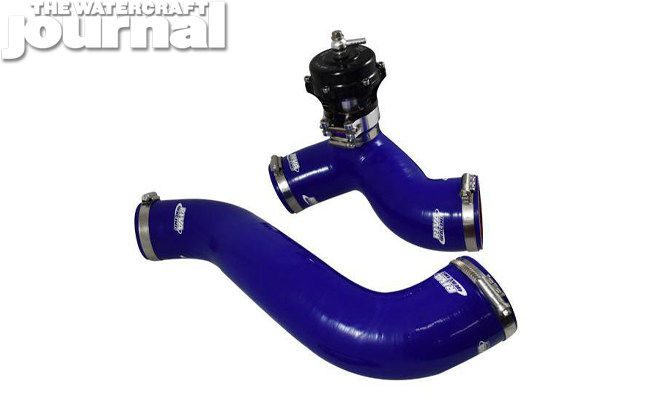
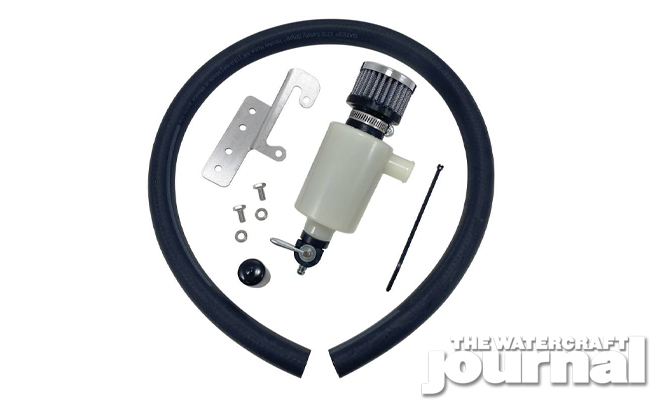
The Sea-Doo RXP-X received the 2021 RXP-X 300 Power Filter Kit. To keep power robbing to a minimum, the machines were fitted with RIVA Sea-Doo Catch Can/Engine Breather Kits. These kits are great for eliminating crankcase fumes and oil vapor from the Sea-Doo engine’s air intake and the kits also kick up the horsepower by removing the requirement to burn non-combustible oil.
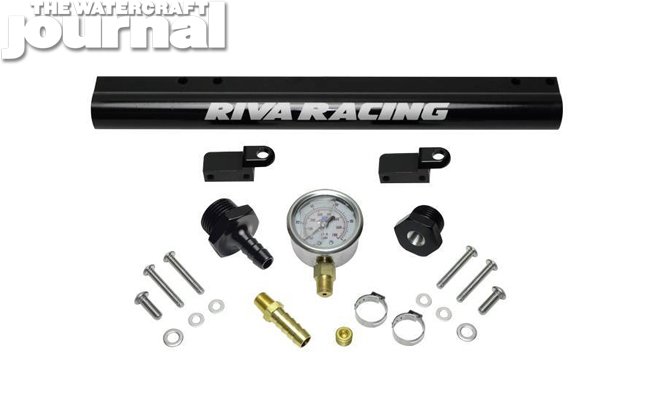
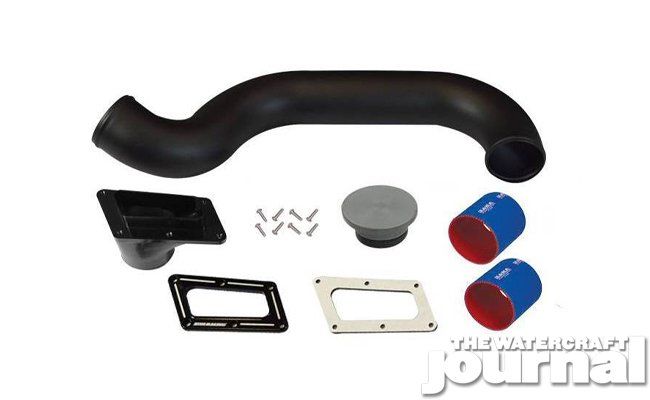
Adding more horsepower, is a RIVA Sea-Doo High Flow Billet Fuel Rail. This component is essential for getting the most out of your fuel system. It replaces the restrictive factory fuel rail for improved fuel delivery. Now we’ll move into the sleek RIVA Sea-Doo RXT/GTX All Rear Exhaust Kit. The RIVA Sea-Doo Exhaust Kit is an outstanding piece of equipment. It is stylish and fits nicely between the water box and hull exit, keeping nasty black streaks off the back of your ski. The kit reduces back pressure for improved performance and has no sound suppression.
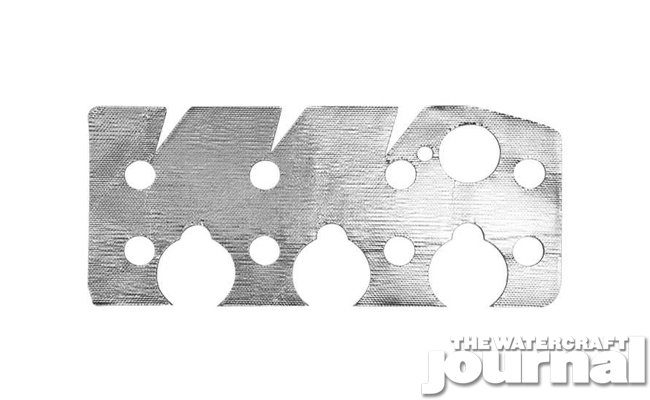
For lowering intake temperatures and increasing power, a lightweight RIVA Sea-Doo 300 Valve Cover Heat Shield was installed. A Solas Sea-Doo Concord SXX 13/18 Impeller was added to the Sea-Doo RXT-X 350. The Solas impeller increases low-end thrust and top end speeds on the Sea-Doo 300-horsepower PWC. To improve handling and straight-line stability, RIVA Sea-Doo Pro-Series Sponsons were installed. The rigid fins are fully adjustable, giving you the ability to control the amount of influence they have on the craft.
Also added to the runabout handlebars, were a pair of RIVA Sea-Doo Billet iControl Levers. The aluminum throttle and brake levers are a direct replacement for the stock plastic levers. The levers offer more responsiveness, control, and comfort when racing. This could lead to less finger fatigue.
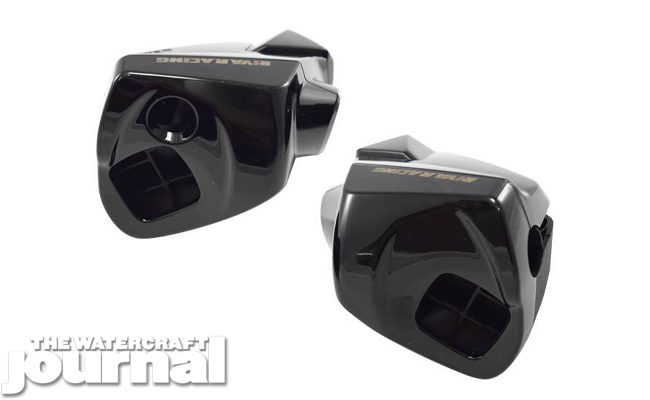
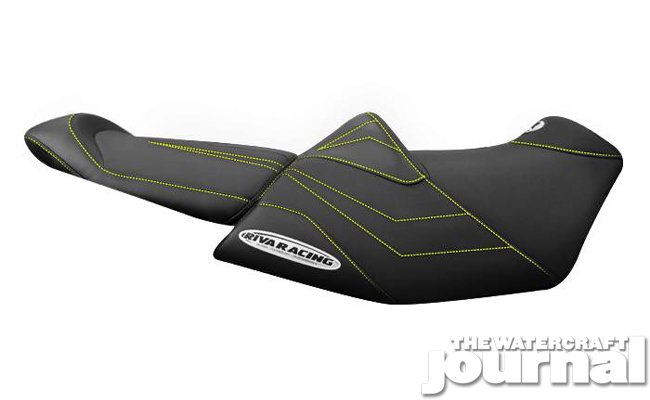
Another addition to the Sea-Doo RXT-X, is the RIVA Sea-Doo Control Switch Housing Set. The set replaces the bulky OEM control housing. Rounding out the Limited Edition RIVA custom Sea-Doos are the seat covers. The RIVA Sea-Doo Seat Cover is black with the neon yellow stitching for tying it all together.
The Limited Edition Sea-Doos were developed for competition use only and designed for racers who demand the ultimate in power and performance. For additional information on the parts upgrades, check them out on the RIVA Racing website or follow the links provided.
Are you one of the jet ski riders who dreads the thought of cleaning your PWC after an exhausting day of riding? Well, Jet Ski Camping has compiled a helpful list and video to make your life easier and we’re sharing it with you.
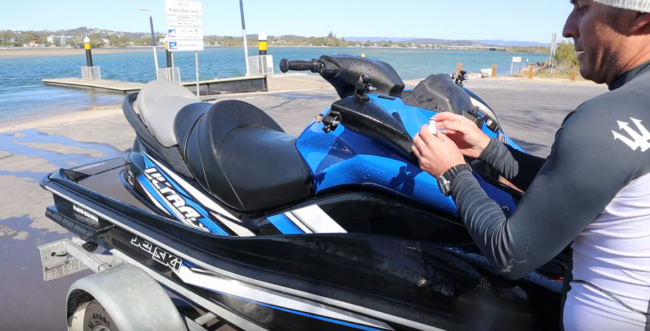
The first thing you want to do is purchase a garden hose wand. The wand should measure at least two feet in length and has an on/off trigger. Find one with a thin adjustable nozzle because it will make it easy to clean out those hard-to-reach places. One of those areas is part of your trailer frame. It’s a good idea to get inside the frame openings because trailers typically rust from the inside out. Stick the hose in one end of the frame. Check out the video for the sponge trick.
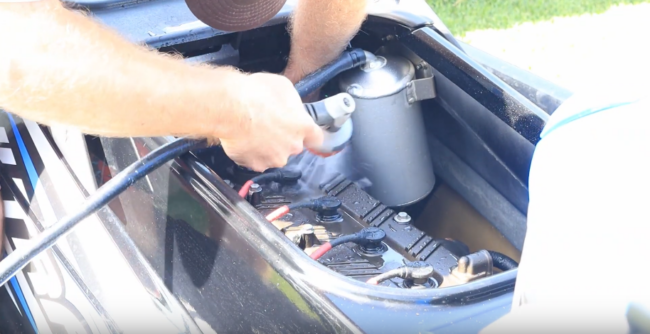
Prior to washing the engine bay, give it a good look and see if any water is inside the compartment. This little trick could save you from sinking. The compartment should be dry and watertight. Once you have checked for water, give the engine a good spray, making sure to not spray inside the air intake. Cover the air intake with your hand while spraying to keep the water from entering.
After you’ve rinsed the engine, unscrew the drainplugs from the rear and lift the jockey wheel onto an upside-down bucket to get your trailer tilt on. This will drain the water from the engine compartment.
Occasionally, it’s a good idea to rinse the engine mounts. Jet Ski Camping does this by filling the hull with one or two inches of water, which will cover the deep-seated mounts and they’ll get a good rinse.
A good jet ski flushing can be done at the boat ramp if it has a spigot and you have your hose with you, and it isn’t too busy. You can leave your drain plugs on the way home so that the water can drain while you drive. Take the route with the most hills. We see guys leaving the nearby boat ramp with water gushing out of the backs of their boats. Whatever works!
Also, you don’t want to skip the foot holds. Mold and rust love those areas. Simply take a sponge and soak up the water.
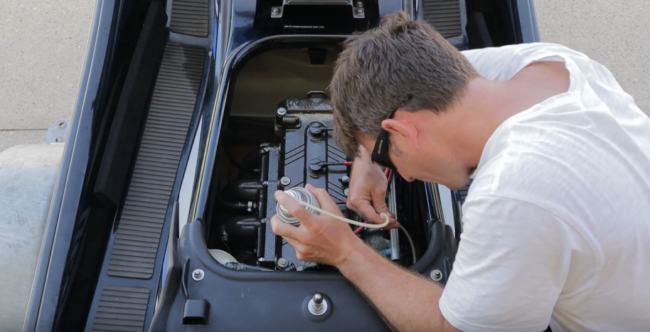
Before putting the cover back on your craft, give the engine a good anti-rust spray using an extension hose with a 360-degree nozzle attached to a can Fluid Film. The 360-degree nozzle hose will give you the ability to properly coat and protect everything.
Save yourself some time and save your ski from saltwater corrosion by following these simple tips from Jet Ski Camping!
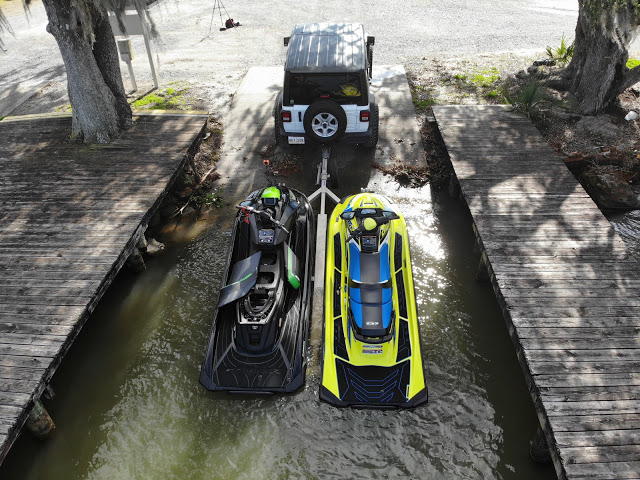
For those paying attention, you will have known that The Watercraft Journal’s own Kevin Shaw was recently down in Morgan City, Louisiana to join Greenhulk.net’s own Jerry Gaddis and his son, Greg for a very special day of testing. We brought down a nearly brand-new 2020 Yamaha GP1800R SVHO (touting a paltry 14 hours on the clock) to place up against Jerry’s near-showroom new 2021 Yamaha GP1800R SVHO to conduct a little showdown of our own accord.
It didn’t take long to see that the 2021 model truly stands above all other GP’s who came before it, and while neither this article or Greg’s video below will reveal the final results – those will be revealed in a soon-coming full-length video from The Watercraft Journal in the next week – we will tell you that the 2020 put up a good fight and is a worthy opponent, but if you’ve got a stock 2018, you’re gonna want to sell that bad boy on Facebook Marketplace as soon as possible.
Again, the full length video and article will be published exclusively on The Watercraft Journal and our YouTube channel in the coming week, so please do not miss out. If you’re a “Yamaha guy” this is gonna knock your socks off.
Man, 2020 was a crazy year (and frankly, 2021 ain’t looking all that rosy either) and a major surprise for many in the personal watercraft racing community was the delay of the Jet Ski World Cup (y’know, the “King’s Cup”) from its usual spot in early December to all the way until April 21st-through-25th of 2021. While this certainly messed up a lot of people’s racing ambitions, heavy travel restrictions due to COVID-19 made hosting the event earlier an impossibility.
Now with vaccinations being widely distributed and authoritarian lock downs being eased in many countries, Pattaya, Thailand’s World Series event is nearing closer. In preparation for the big event, organizers recently published an overview schedule for the week’s racing, which you can read HERE. Obviously, for those stateside, there’s quite a bit of preparation needed, so it’s best you jump on your reservations now and start arranging for transportation of your ski, gear and other necessities.
It wasn’t too long ago that The Watercraft Journal published the tentative schedule for the 2021 P1 AquaX race schedule, and now the racing body just announced that Yamaha Motor Corp. USA is back on board as the title sponsor for the series. Of course, with Yamaha WaveRunners absolutely dominating the closed course and offshore super course-style race format, it’s no wonder.
Both the FX SVHO and GP1800R have remained favored weapons-of-choice of the series’ top athletes and it’s likely to continue, particularly as Yamaha and P1 AquaX have agreed to permit the 2021 Yamaha SuperJet compete as well. We’re excited to see how this year shakes out too – as Sea-Doo’s newly redesigned RXP-X 300 promised to give the big SVHO-powered Yamahas a run for their money.
Here’s the entire press release from P1 AquaX: Powerboat P1 and Yamaha Motor Corporation have jointly announced that they will be continuing their watercraft racing partnership in 2021. Entering its fifth year, the relationship is an outstanding example of leading manufacturers using the P1 AquaX race series as a marketing and promotional platform.
Bryce Parker, Marketing Logistics Supervisor at Yamaha WaterCraft Racing, explained: “We understand the importance of racing and the impact it has on our business. We are looking forward to the year ahead and hoping that the return of a safe environment will allow for a normal race season. We will continue to enthusiastically support P1 AquaX, our dealers and our racers. With the release of the new GP1800R and SuperJet it promises to be a very exciting year.”
For over 30 years, SuperJet has been the pinnacle of stand-up, creating a world of racing around it, and in August this year Yamaha announced the launch of the all-new 2021 SuperJet WaveRunner. It features a complete redesign since the introduction of the WaveRunner line in 1990, with an entirely new hull and now powered by Yamaha’s three-cylinder four stroke TR-1 marine engine, and will compete in the AquaX Sprint division next year.
The GP1800R, which Eric Francis rode to victory in the P1 AquaX Bahamas World Championship in 2019, has experienced a significant redesign for 2021 with the new hull producing improved handling. It looks set to be the Yamaha racers’ watercraft of choice in the AquaX Enduro 300hp class.
“Partnerships are at the heart of our business and being supported by a world class manufacturer like Yamaha speaks volumes for our AquaX race series,” said P1 USA Championship Manager Michelle Petro. “The successful relationship began in 2017 and, with no racing at all being possible last year, 2021 will see AquaX celebrate its tenth season of racing.”
The P1 AquaX USA Championship kicks off in Daytona Beach in April.
As we ring in the New Year with hopes for many bright and fun-filled times on the water, it’s worth having a look back at 2020 to see some of the highlights that many Sea-Doo riders had.
Judging by the video re-cap it seems that many riders were not letting a worldwide pandemic get them down and instead chose to take advantage of every opportunity. Take a look at this video that shows some of the best highlights of 2020 from riders all around the world.
Sea-Doo would also like to wish everyone a Happy New Year as they write this warm and comical message to a year that we will surely remember for a long time.
Dear 2020, It’s been real. While you’ve certainly thrown us a few of the best curveballs we’ve seen in quite a while, you’ve helped our riders rediscover the freedom we crave and the passion we have for the Sea-Doo Life. Here’s some of our best from this past year to remember us by. Yes, we’re breaking up. It’s not you, it’s us… no, wait, it’s definitely you!
To everyone who shares a passion for the open water, we hope you have a safe, happy, and healthy New Year! We can’t wait to see what 2021 has in store!
As personal watercraft have rapidly ballooned in size over the decades, manufacturers have had to find new and creative ways to help keep weight down. To counter packing on some serious pounds, companies like Sea-Doo have invested millions into developing different forms of plastics to replace heavier fiberglass, all while retaining strength, rigidity and the watercraft’s overall aesthetic.
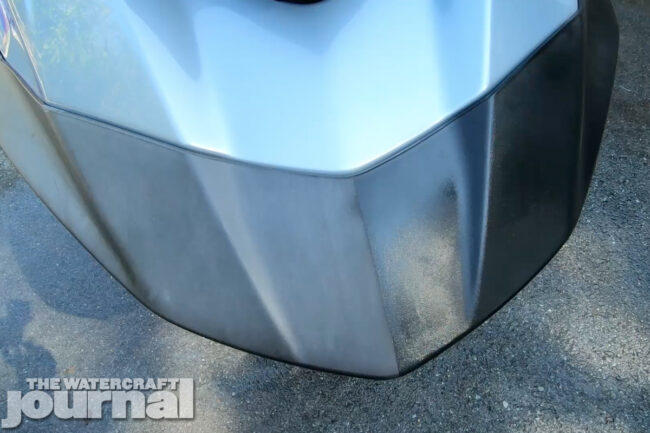
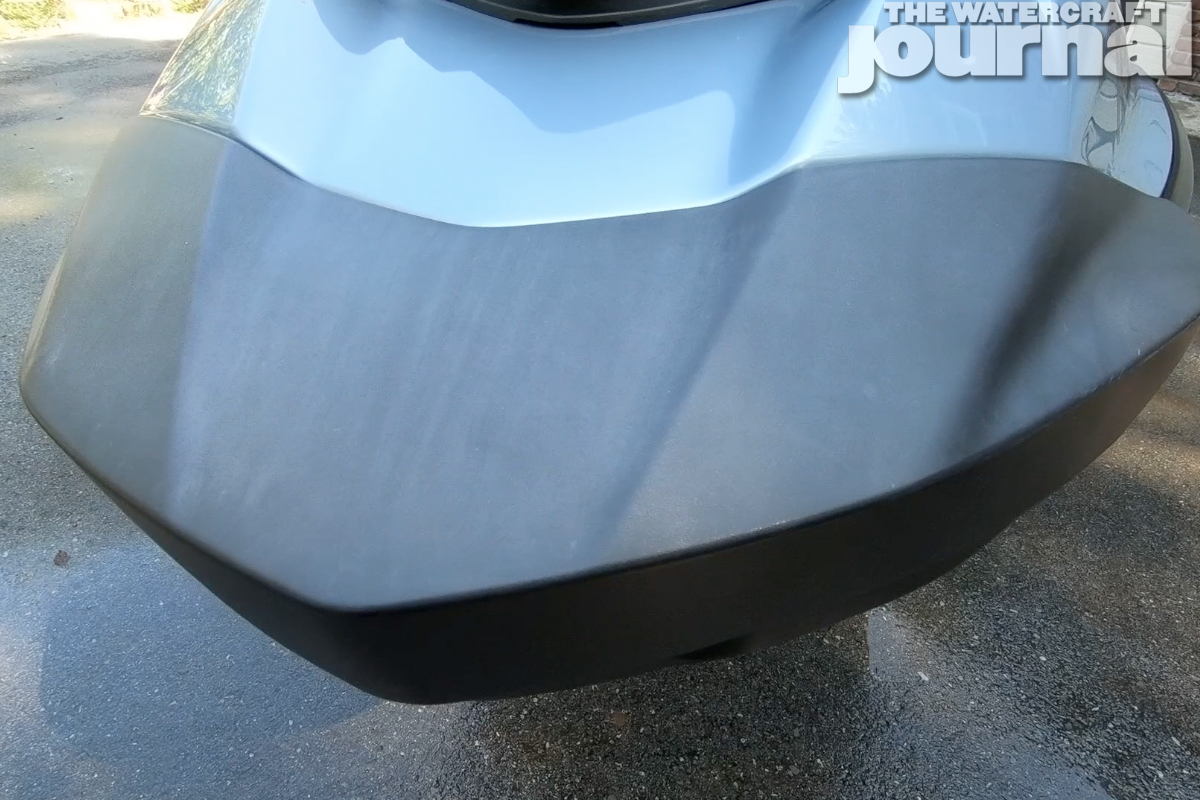
This means that today’s watercraft are more and more typically black molded plastic than painted surfaces. Unfortunately, despite modern blends and advanced treatments, black plastics can quickly fade if left uncovered. Damaging UV rays can leech away vital elements in the plastic’s polypropylene composition, leaving it bleached white and if left out too long, even chalky and flaking apart.
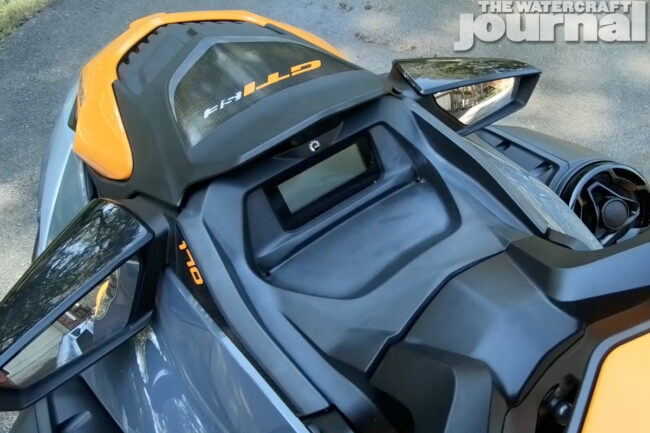
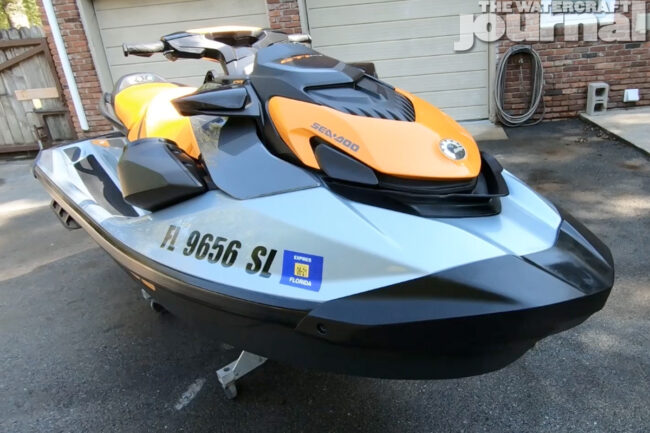
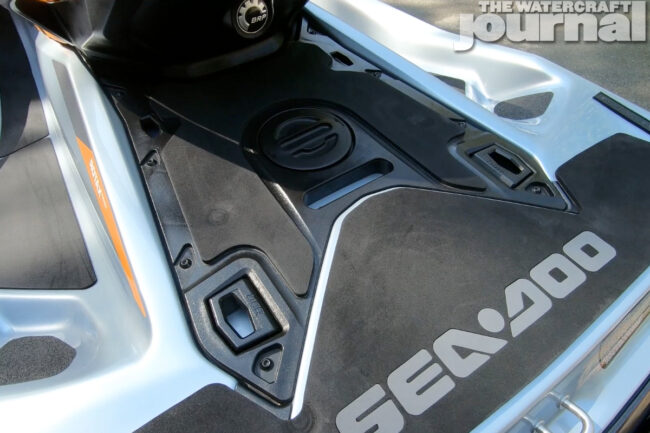
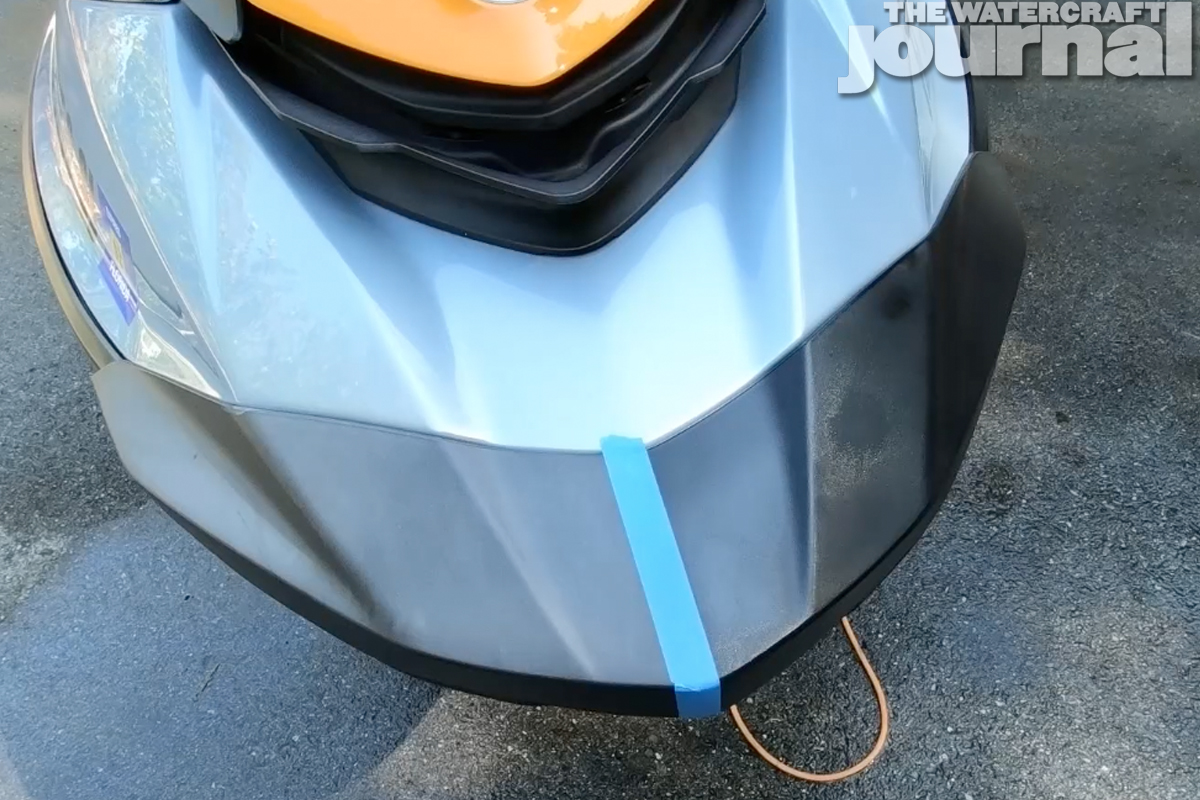
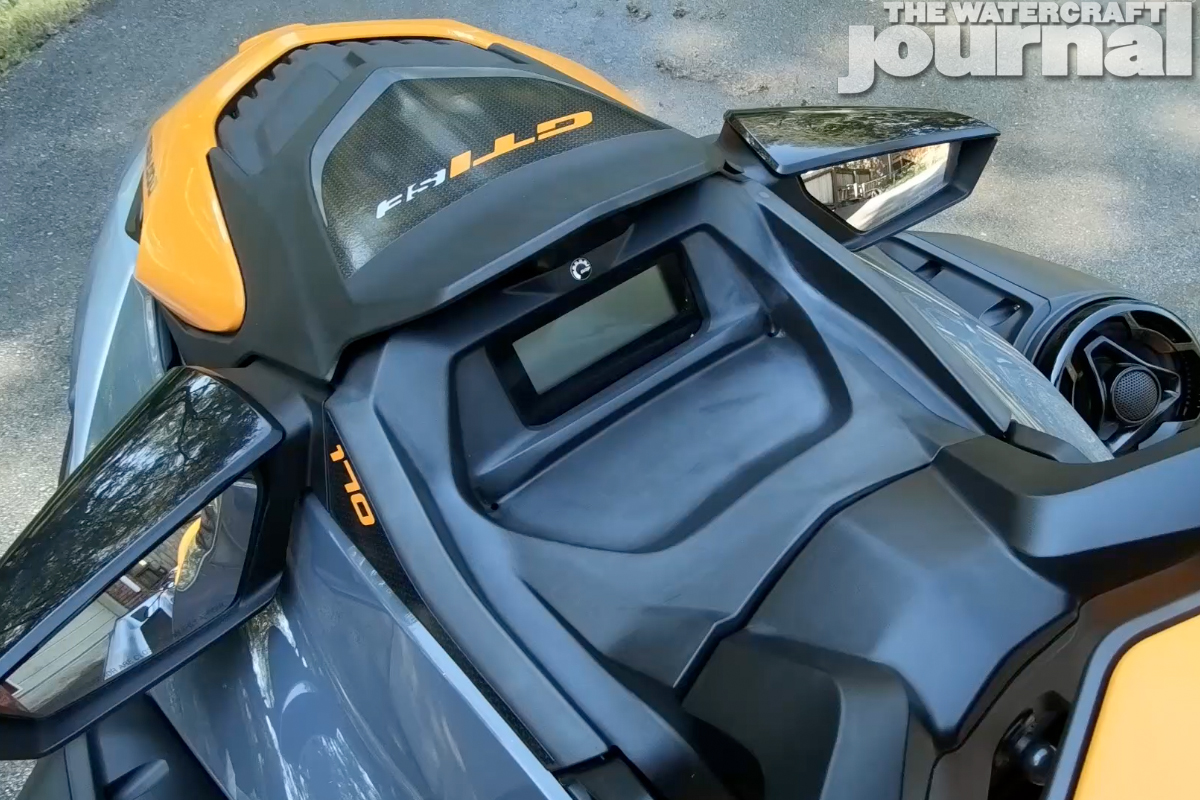
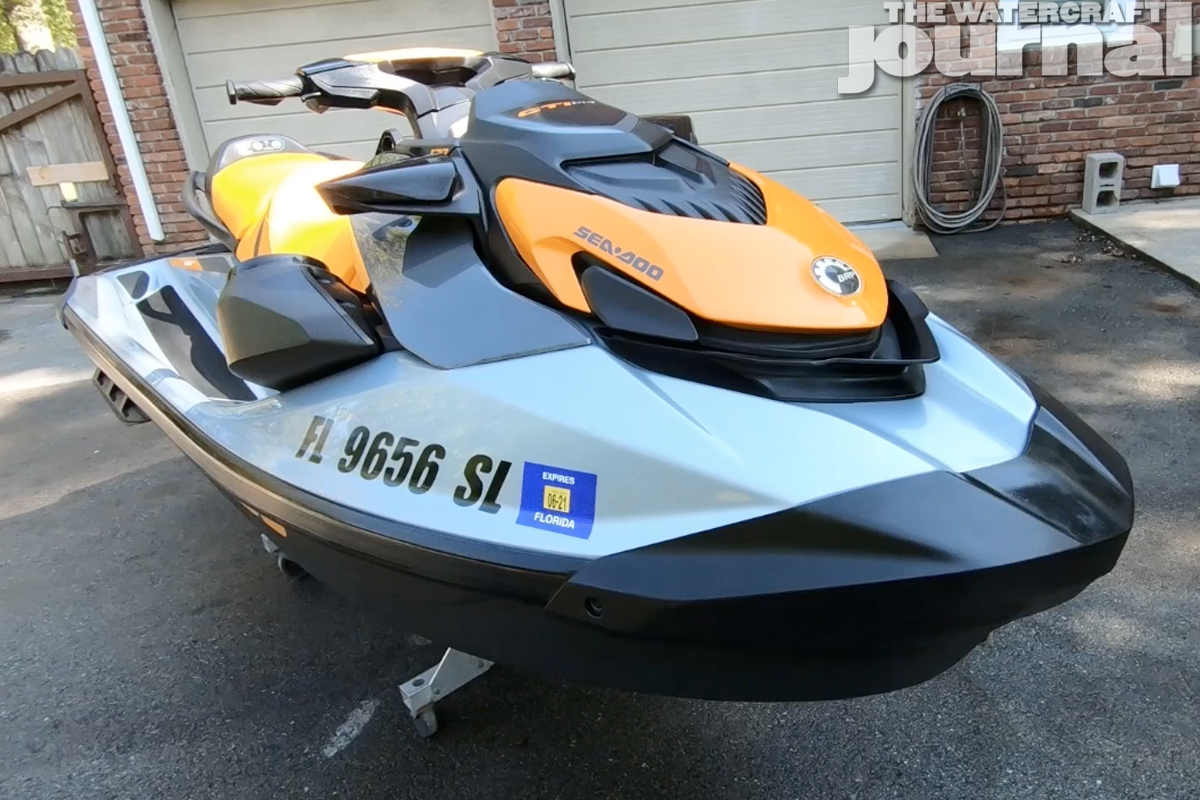
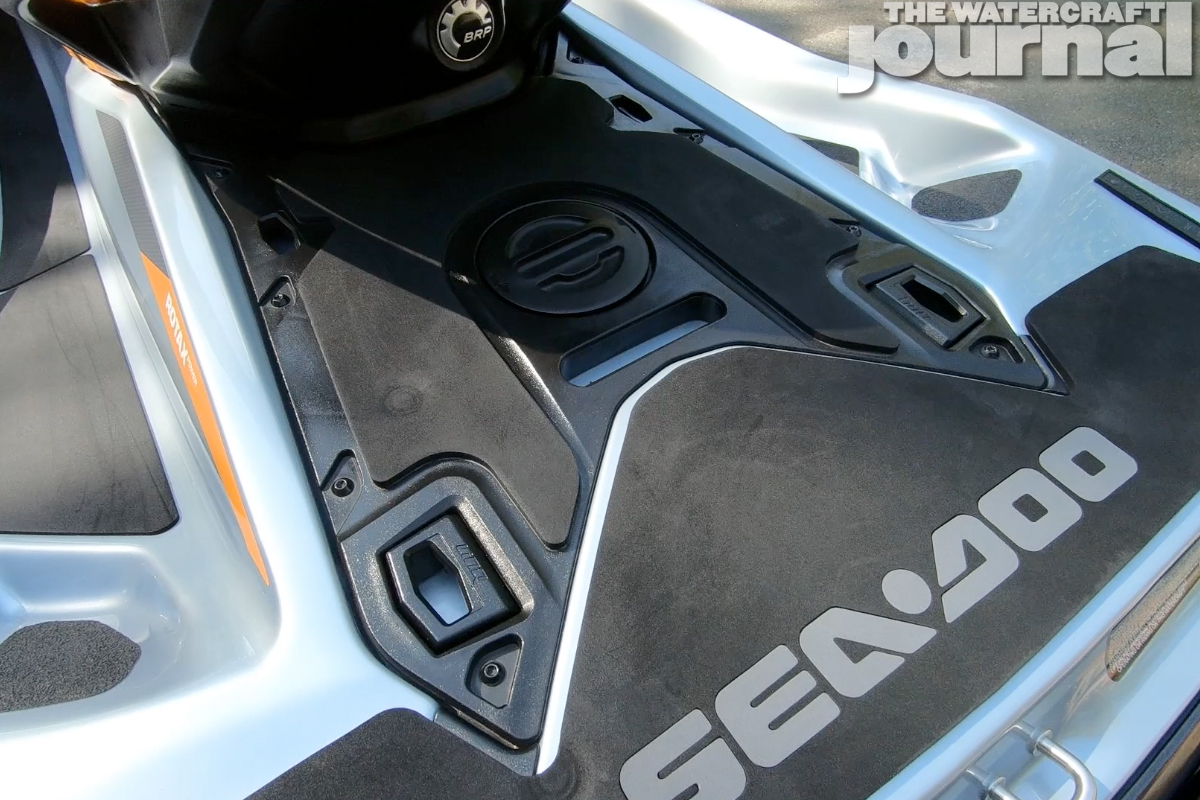
Although our 2020 Sea-Doo GTI SE 170 came brand new to us this last April, without the use of a good UV-filtering cover and frankly, a summer of continued riding, saw our ski’s plastics quickly begin to fade. To battle this, we tried every topical treatment from XPS, and even dipped into our vast collection of automotive and marine-grade detailing chemicals to no avail.
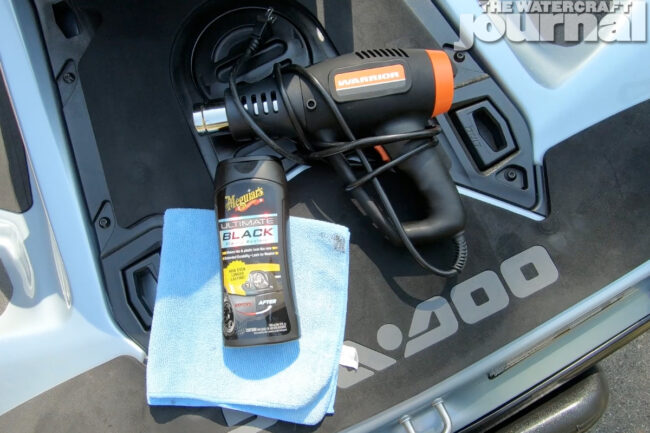
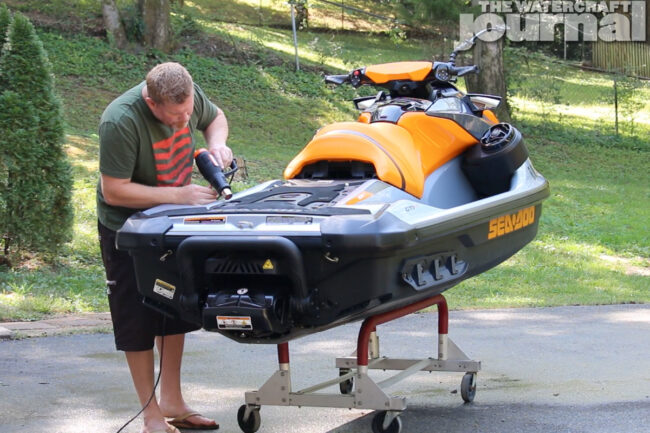
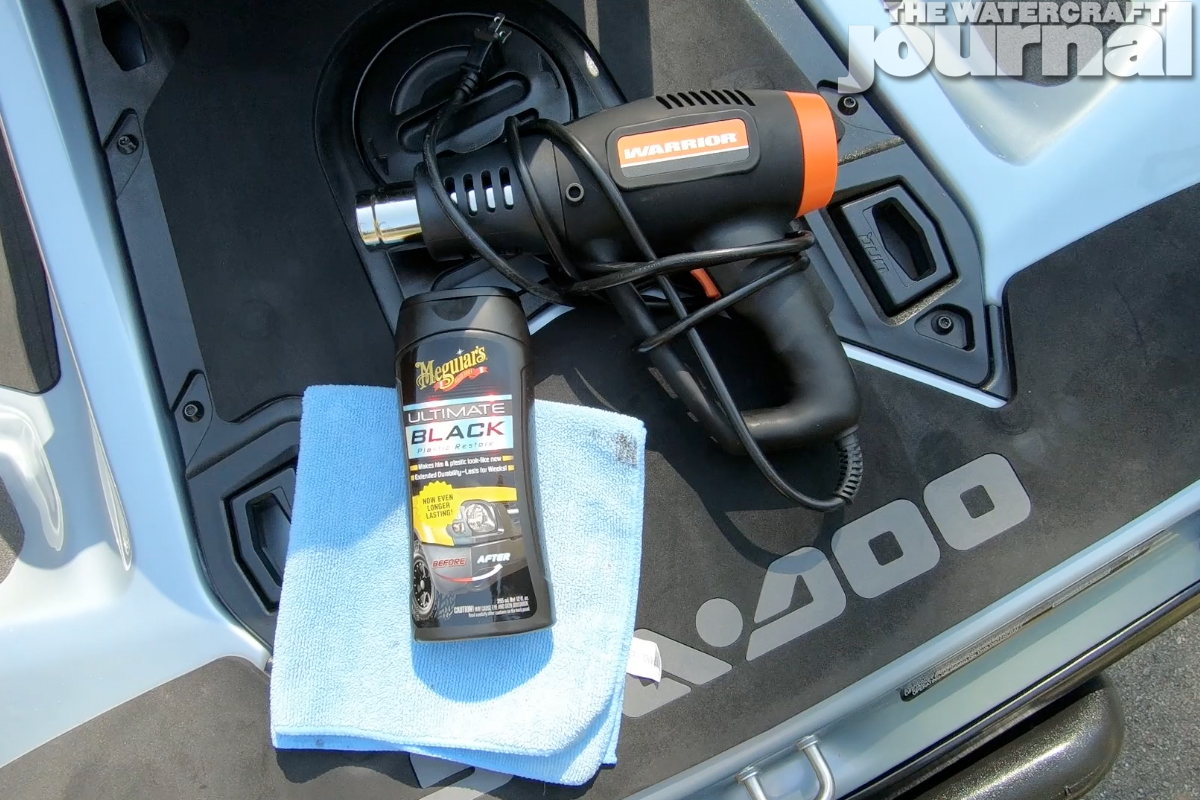
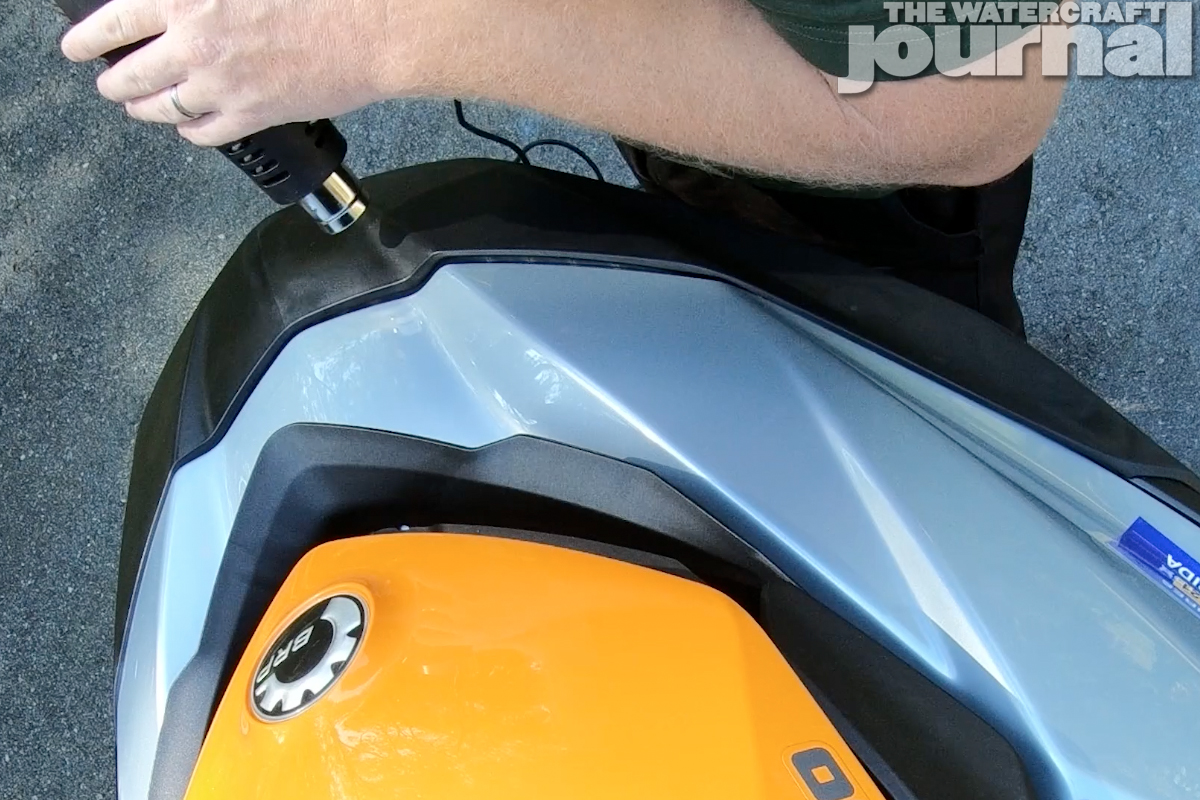
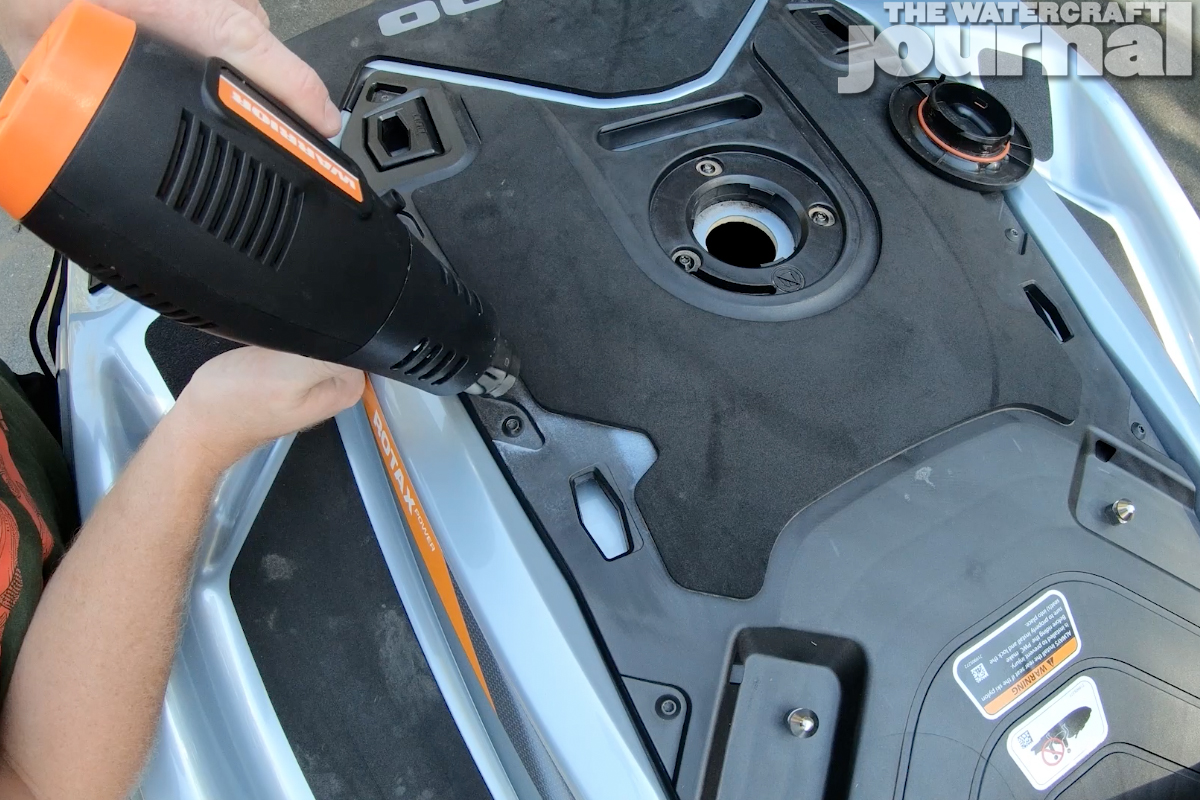
Before things got too bad, we’re going to show you how we restored our Sea-Doo using the single-most effective way to bring a near factory luster back to black plastics – and that is by using a heat gun. Thankfully, dedicated heat guns are surprisingly affordable and easy to find: we picked ours up at Harbor Freight for just over $20. [Note: we are following both BRP’s Polytec repair steps as well as the plastic restoration guide by ASE. – Ed.]
And no, your wife’s hair dryer won’t work here. Hair dryers do not generate enough focused heat, as they’re meant to blow warm air not act as a service tool. Please don’t cut corners here. And obviously, don’t start until you’ve cleaned your surfaces of any waxes or treatments, as these can react negatively to the heat process.
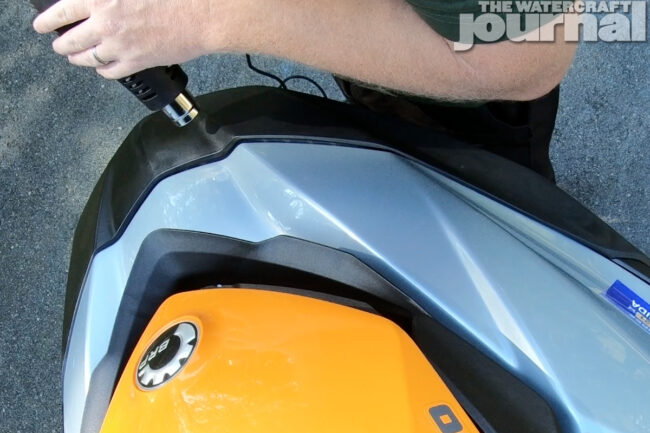
Treating faded plastics with heat works by slowly breaking down the plastic’s molecular composition, allowing the chemical bond to realign as the polymers cool, leaving a wet, glossy surface. This process is tricky as the substrate can melt quickly if too much heat is applied at once. The key is to keep your heat gun consistently moving and roughly 4-to-6 inches away from the surface.
It’s important to note that as you’re trying to restore your faded plastic’s shine, you’re also wanting to maintain its textured surface. If too much heat is applied, you can literally melt the plastic, leaving a glassy smooth – albeit discolored – surface. That is why patience and consistency is paramount here. Take your time and pay attention to what the plastic is doing.
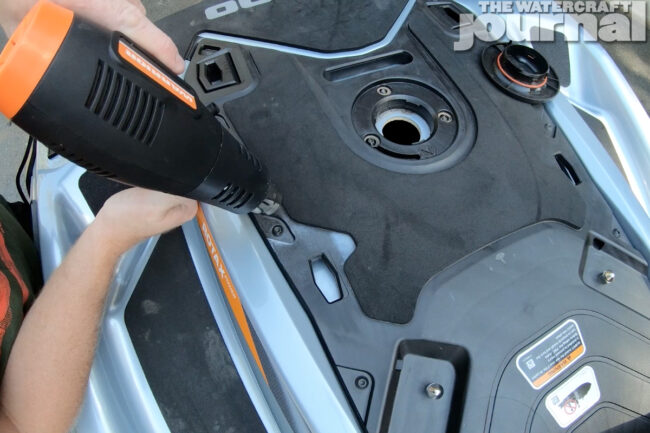
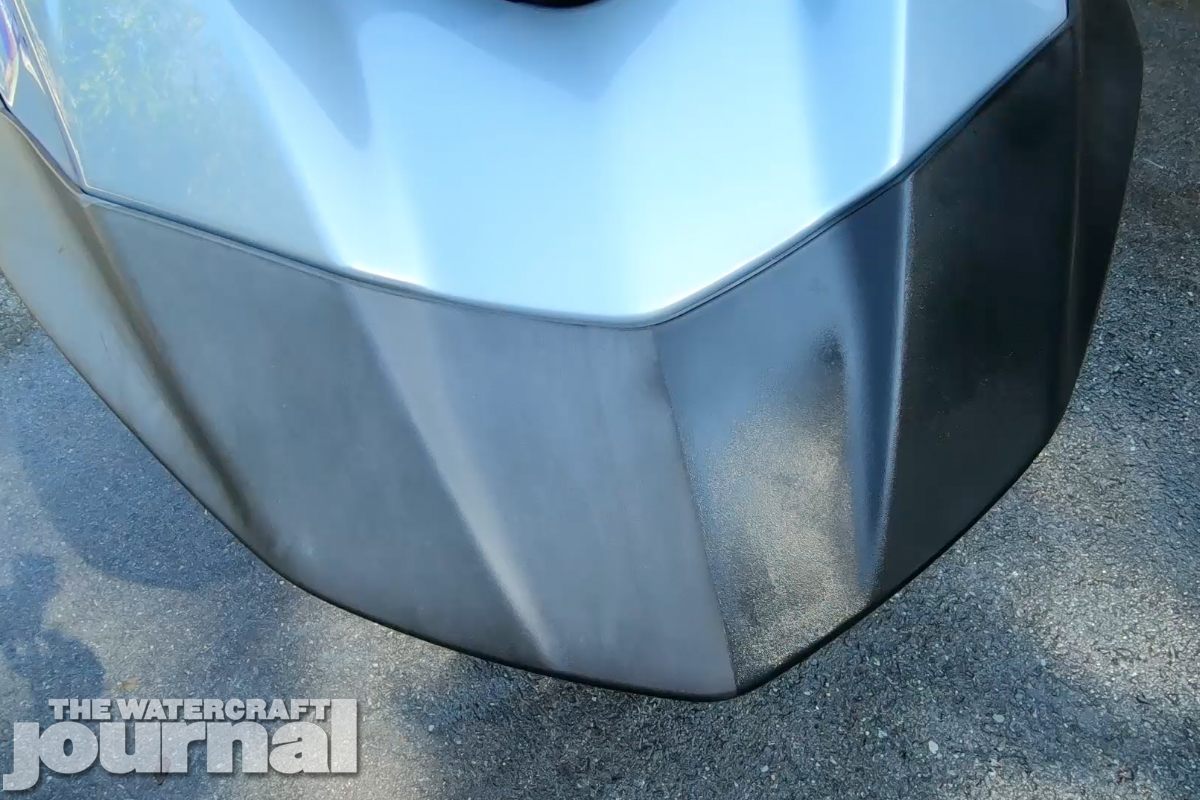
As intense heat is focused on the plastic’s surface, you’ll see spots begin to appear – this is what is called “sweating.” As you move your heat gun’s tip in a concentric pattern around the area, you should see the sweating increase, slowly deepening the color and returning back to a deep, rich black.
If you see some spots begin to become shiny, back away and let it cool off a bit, as that’s a sign of too much heat and the substrate is beginning to melt. Thankfully, you can always pull back and let the surface cool to observe your progress, then reapply heat and pick up where you left off. Plastic can be pretty forgiving in this way.
Although the transformation process happens quickly in front of your eyes, its again, super important to be patient, pace yourself and be consistent. It’s also helpful to aim the tip of the heat gun perpendicular to the surface, meaning adjusting your angle to the contours of the plastics. These parts have lots of highs and lows, and its easy to overheat one area while trying to treat another.
In restoring our Sea-Doo, we treated each panel one at a time. Prior to each panel cooling, we also applied a liberal coat of Meguiar’s Ultimate Black plastic restorer to the warm surface with a microfiber towel. This protectant is one of the few on the market that isn’t a wax but is an actual penetrant, chemically adhering to vinyls and plastics unlike others that merely produce a surface layer of UV protection.
The final result of less than an hour’s worth of work is hard to deny. Obviously, this is not a permanent solution and will still require proper care and protection, but this will help extend your plastic’s life a while longer. Equally, older plastics or those with heavier UV damage may require several passes, but the process is identical – and even for colored plastics as well.
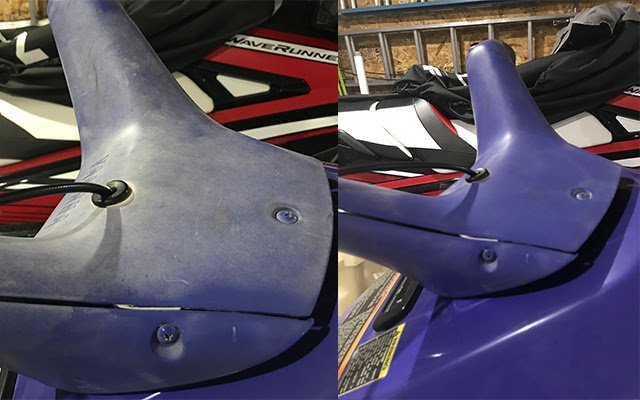
After seeing our latest video, a reader named Rodney shared, “This is a nice trick. [This is my] 1994 Yamaha WaveRunner III before and after [using a] heat gun.”There’s no reason to live with dull, sun-bleached faded plastics or foot the bill for all new replacements when a little elbow grease on a Saturday morning could have your personal watercraft looking brand new.
[Editor’s note: It’s been 2 months since we performed this treatment, and the GTI SE 170 remains as glossy as the day we performed it. We’ve traveled 1,400 miles with it on a trailer, racked up several more riding hours, and pressure washed it twice – and it still looks great. –K]



 The all white SuperJet provides the perfect canvas for design with its clean lines and refined design. The ski has an actual chiseled appearance, something we don’t often see. The 2021 SuperJet 4-Stroke model comes in at under $10,000 and the IPD graphics cost $339 enabling you to customize a new ski for just over $10,000.