
Home Blog Page 72

Discover why Life is Better on a Sea-Doo

0

Sea-Doo is a leader in innovative technology and is driven to be the best by their riders. The company has built a personal watercraft for every rider. If you’re in search of a family friendly jet ski, they have one for you. The Sea-Doo Spark is perfect for the new rider.

For the rider who demands control when riding a high-performance craft, the Sea-Doo RXT-X is the one for you. Its Rotax 1630 ACE engine delivers 300 HP. Crank up the BRP Bluetooth Audio Premium system and get after it! Sea-Doo also offers the Fish Pro for the angler who likes to get away from it all. The FishPro models have the ST3 platform, which provides stability and space to move around.

All the Sea-Doo PWC offer excellent stability, so you know if you fall off, you can climb back on easily. With iBR technology, you can feel confident about getting out of trouble easier. The braking allows you to stop up 160 feet sooner and give it another pull, and you can back it up.

If you find yourself in with weeds or trash getting sucked into the water intake, with the push of a button, the iDF pump system will unclog the intake. Sea-Doo’s powerful Rotax engine is one the most reliable on the market and has excellent fuel efficiency. Sea-Doo has built one of the toughest hulls on the market. Its Gen II Hull is super strong and lightweight.

The new 7.8-inch-wide panoramic LCD Display lets you have all your important info at your fingertips. If you’re like some of us, you like to go on adventures. That’s where LinQ accessories come in. Easily add a fuel caddy, a cooler, a bag, or a box to complete your watercraft. Check out the Sea-Doo website for more information and to get your next ride.

Check out Valentina Lezcano’s Matching Unlimited PWC Gear

0

Unlimited PWC team rider Valentina Lezcano is stylish in and out of the water. When she’s racing her black and pink stand up jet ski, she color coordinates her Unlimited PWC riding gear with the jet ski.

Her GP1 has pink handle grips, and her key lanyard Is pink, which act as accents to her pink and black ski. She uses the Floating Lanyard for Kawasaki and Yamaha.

It is weighted different than most, so it doesn’t go wild when Lezcano is flying down the course.

The lanyard will run you $18. Her Rush S/E Life Jacket also makes for a nice accent piece and works well for pulling out the black on her jet ski.

It is also a great USCG Approved PFD, so it will keep Lezcano floating if she’s falls.

This is a side entry vest made of lightweight nylon. The back of the vest is flat, which makes for less stress when riding.

The PFD has three buckles on the side for easy on and off. She wears a black and gray Rush Wetsuits Jhon to tie it all together.

This wetsuit was designed by professional riders for professional riders and after extensive testing, it was released to the public. The Rush Jhon is made of super stretchy flex neoprene with Velcro on the left shoulder and ankle zippers for easy in and out.

The flex neoprene is lighter than some other neoprene on the market. This makes it feel better on your skin and you will feel less fatigue after a long day on the water. The Rush Wetsuits John comes in at $169. Check out Lezcano’s gear on the Unlimited PWC website and create your own look!

Video: Yamaha Motor’s 2050 Environmental Plan Hints at End of High Performance WaveRunners

0

It seems like everything is becoming political these days. Every big box store, shoe maker, brewery and entertainer feels compelled to voice their stance on one topic or another; and all too often to the chagrin of their customers. Even the relatively intimate personal watercraft industry is not immune. In recent years, the Yamaha Motor Company has made more outward moves into the political arena than any other OE manufacturer, leading many to wonder what is the driving force behind it all.

More significant are the implications behind developing websites, producing videos and unique web content that focuses less on Yamaha’s products and more on global socio-environmental issues. These all require a considerable investment of capital. Even politically charged social media posts have their cost. So what would drive a motorsports manufacturer to commit millions of dollars into extraordinarily expensive non-endemic ventures?

It’s important to note that while not alone in doing so, Yamaha has been the most public – making them the proverbial “canary in the coalmine” from which we can study. This article intends to observe what positions Yamaha has taken, reveal Yamaha’s intent to participate in a global agenda as outlined by the Paris Agreement on climate change, and the UN’s Sustainable Development Goals (SDGs), and detail what these positions imply for future products.

Establishing a Pattern
On October 28th, 2021, Yamaha released “Above & Below” as part of its then-new Run The Water video series. Shot in a documentary-style, both the first and second chapter – “The World’s Aquarium” (published August 1st, 2022) – carried a strong conservationist message while following professional divers and sea life photographers, respectively.

This wasn’t surprising. Yamaha has been active in conservationist efforts for decades through its Rightwaters campaign. Demonstrating its “long-standing dedication to preserving the natural resources we have today so that our customers can continue to enjoy them tomorrow,” Yamaha participates in beach cleanups, sponsors wildlife courses and actively seeks to streamline its manufacturing processes.

On December 1st, 2022, Yamaha launched Women Run The Water, a website dedicated to “a movement that encourages and supports women who want to take control of their boating or personal watercraft experience. […] We’re changing the way women spend their time as they break away from conventions.”

At the time, consumers didn’t know what to make of it; some panned the launch as a mere marketing contrivance to reach a budding customer demographic and a method to sell additional apparel. Others noted that the financial investment to launch such an endeavor appeared to far outweigh the potential for sales, raising eyebrows.

As of this writing, the video announcing Women Run The Water has 1,787 views despite the manufacturer’s vast global audience of enthusiasts; a surprisingly poor response. The statistic Yamaha used to ignite Women Run The Water stems from the National Marine Manufacturers Association (NMMA) which stated that an all-time high of 17.9 million women “enjoy boating and fishing” in the US.

In discussing the Women campaign with The Watercraft Journal, a leading Florida powersports dealer estimated that 95% of annual watercraft sales are made by men. Calculating that 50% of adult American men are unmarried, we’re looking at roughly 47.5% of the total purchasing decisions being made by single men without any female input. So why, the dealer representative queried, would Yamaha focus on 5% of the market instead of this consistent 47.5 percentile?

Then, in a March 8th post to its Facebook account celebrating International Women’s Day, Yamaha wrote: “It’s not just about being the captain but having the power to choose. By empowering women around the world to take charge of their destiny, we are setting the stage for an exciting future.” [emphasis added] Many across social media noted the peculiar word choice and ill-timing, wondering if Yamaha had made a veiled pro-abortion post only weeks after the SCOTUS overturned the 1973 Roe v. Wade decision.

This led fans to wonder had Yamaha gone woke? Anheuser-Busch (ie. Bud Light) and Target are currently experiencing apocalyptic boycotts, plummeting 25% in sales and losing over $15 billion in stock value, respectively. Surely, Yamaha wouldn’t follow. Right? After a month’s investigation, it became apparent that not only has Yamaha been actively engaged in domestic and global sociopolitical issues, but has openly announced its intent to do so in a document titled, “Yamaha Motor Group Environmental Plan 2050.

In its introduction the document states that Yamaha is expected “by the international society” to “proactively undertake Environmental, Social, and Governance (ESG) issues, such as the signing of the Paris Agreement on climate change, and the UN’s Sustainable Development Goals (SDGs)” declaring, “Going forward, Yamaha Motor will continue aiming for [the] achievement of a sustainable society. As a company that proactively addresses ESG issues, we established the Yamaha Motor Group Environmental Plan 2050.” [emphasis added]

Proactively Addressing ESG Issues
No doubt you’ve heard the acronym “ESG” being tossed around, but what is it? According to the Corporate Finance Institute (a subsidiary of investment juggernaut BlackRock), “An ESG score is an objective measurement or evaluation of a given company, fund, or security’s performance with respect to Environmental, Social, and Governance (ESG) issues.”

This score can be raised (or lowered) by a company’s “percentage of employees per employee category, by age group, gender and other indicators of diversity (e.g. ethnicity)” or efforts towards “environmental issues like carbon emissions, climate change, water, and forestry.”

Companies are graded on the diversity of its staff, and the strides it makes to better society and/or the environment by independent finance and investment firms, consulting groups, standard-setting bodies, non-governmental organizations (NGO), and government agencies.

Image: Gensler

Companies with positive ESG scores may be rewarded with favorable financing rates, loans and tax incentives. And conversely, low scores can result in the inverse. That is to say that under this model, it is in the best interests of any company to make overt gestures demonstrating its compliance, or face severe financial repercussions.

Thus far, Yamaha’s Women Run The Water campaign and its International Women’s Day post works towards the company’s Gender Equality requirement (Goal #5 of UN’s Sustainable Development Goals). Equally, its Rightwater effort manages to tick two of the UN’s SDG’s, namely Climate Action & Life Below the Water. While none of these satisfy the Department of Economic and Social Affairs’ demands, they do show effort. 

Within its Environmental Plan 2050, Yamaha outlines sweeping goals of reducing CO2 emissions by 90% from all products; promote recycling; strengthen environmental conservation and biodiversity; reduce waste materials; eradicate forced labor, human trafficking, and child labor; increase employment for socially vulnerable people; curtail corruption and bribery; promote safe and secure work environments; advance diversity and inclusion; and eliminate discrimination against women/protection of human rights (just to name a few).

Becoming Carbon Neutral by 2050
While introducing the new microphone system [a technology allowing riders to vocally activate their synced phone’s AI and place a phone call] at the media reveal of the 2022 models, Yamaha WaveRunner Product Manager Martino Ruggiero said to those present, “[Customers] don’t care about performance anymore. They’re asking for better fuel mileage and features like smartphone integration.”

This sent those of us present reeling. Our instinctual reaction was to become defensive of the performance community and advocate its validity. But Ruggiero’s words had far, far greater implications that none of us immediately grasped. He hadn’t made a declaration but rather a veiled caution of things to come.

Employees involved with product development work on multiple projects simultaneously. While yes, they’re engaged with testing and troubleshooting of current products, they’re also working on vehicles five years ahead of what we the public will see. While the public anticipates the yet-to-be-revealed 2024 WaveRunners, they’re preparing for the 2030 models.

The Environmental Plan 2050 details how the Yamaha Motor Group will achieve carbon neutrality by 2050: primarily through radically improving the fuel efficiency of its internal combustion (ICE) powertrains; expand its battery electric vehicles (BEV) offerings; and develop new diversely-powered CN powertrains (hydrogen, biofuel, and synthetic liquid fuels, which are derived from renewable energy sources).

Equally, Yamaha seeks to reduce CO2 emissions from its manufacturing process with a goal of achieving carbon neutrality in 2035. This is achievable through reducing CO2 emissions generated during production and logistics (transportation). Additional actions include the further recycling of materials; greater support of environmental initiatives and conservatism; and increased “compliance with environmental laws and regulations.”

As outlined in the plan, Yamaha is actively redesigning its naturally-aspirated ICE engines for greater efficiency and lowered emissions. Simultaneously, Yamaha is expanding its lineup of electrified scooters, mobility vehicles and motorcycles. [Note: full electric powertrains are ranked as the most desirable (over hybrid HEV and FCV) by the United Nations Environment Programme (UNEP). -Ed.]

Per the goals outlined, all supercharged ICE applications are expected to be phased out by 2030 as total CO2 emissions are set to be cut by 24% (over its 2010 emissions output) and by 38% in 2035. By 2035, the entire lineup must reach a minimum of a 38% reduction over 2010’s emissions with an optimal goal of complete carbon neutrality. And by 2050, all Yamaha vehicles will be carbon neutral. No ifs, ands, or buts.

As noted previously, Yamaha is developing electric applications for two- and four-wheeled vehicles. They’re not alone in this effort as both Can-Am (BRP) and Kawasaki have released electric on- and off-road motorcycles, which has aided in lowering each brand’s Corporate Average Fuel Economy (CAFE) rating [more on that in a second – Ed.]. Thankfully, don’t expect Yamaha boats and WaveRunners to go electric anytime soon.

In a very clever bit of phrasing, the plan details that the electrification of both outboard and marine engines will only happen as “the spread of the infrastructure for the supply of renewable energy as well as the suitability level of a country or region’s usage environment, the roll out of electrified models is carried out sequentially beginning with industrialized countries” meaning we’ll go electric only when the global infrastructure can handle it.

Image: Edge Hill University

The UN Climate Change Conference & Federal Emissions Regulations
Per the United Nations Framework Convention on Climate Change (UNFCCC) website: The Paris Agreement is a legally binding international treaty on climate change. It was adopted by 196 Parties at the UN Climate Change Conference (COP21) in Paris, France, on 12 December 2015. It entered into force on 4 November 2016.

Many will recall that the USA dropped out of the “Paris Accord” in early 2017 under then-President Trump. Within days after his inauguration, current President Biden signed an executive order quickly re-adopting the accord in January 2021. This meant that not only the federal government of the United States of America fell under the treaty but all industries operating within would be required to follow suit.

These new regulations manifested most potently via the Environmental Protection Agency (EPA) and National Highway Traffic Safety Administration (NHTSA). Through these two agencies alone, environmentalists and political activists levied crushing fines and legal penalties upon vehicle manufacturers making continued operation seemingly untenable.

Image: Sierra Club

For example, in an article by automotive journalist, Patrick Rall, he explains how the NHTSA’s Corporate Average Fuel Economy (CAFE) program fines automakers who fail to reach specific goals set for fuel consumption and efficiency standards. Recently, Fiat Chrysler of America (FCA) was fined $392 million for failing to meet CAFE requirements for the 2016 through 2019 model years.

Per Rall, The fines for the 2016-2018 model years were issued at the rate of $5.50 per offending unit. For the 2019 model year, the rate climbed to $14 per offending unit. For the 2022 and 2023 model years, the fines rise again, to $15 per offending unit. With the same vehicle lineup, the automaker is all but guaranteed to face even larger fines for the 2020-2023 model years. 

To stop the bleeding, Dodge is killing off the current Hemi-powered Challengers and Chargers, with a Charger EV expected to arrive for the 2024 model year. Doing away with the Hemi-powered Challengers and Chargers will help the company avoid more massive CAFE fines. Rall notes Dodge’s shift to smaller engines, hybrids, and electric vehicles for 2024 gives hope of staving off further penalties.

Thankfully, CAFE only pertains to light-duty cars. Right? Not so. On August 16, 2022, the NHTSA announced its intent to issue stricter regulations for passenger vehicles model years 2027 and above, as well as heavy-duty pickup trucks and vans model years 2029 and up. But what about personal watercraft? Where do they fall in? Although the NHTSA and CAFE don’t apply; the EPA does.

Currently, the Emission Standards for Nonroad Engines and Vehicles listed on the EPA’s website are surprisingly unchanged since 2016 – and for the most part, are rather forgiving. Under code EPA-420-B-16-026Marine Spark-Ignition Engines and Vehicles: Exhaust Emission Standards,” federal emissions requirements for personal watercraft and outboard engines haven’t changed since 2010.

Thus far, the ire of the EPA has not been sicced upon the lowly personal watercraft market. We see no agency requiring the three original equipment manufacturers – Kawasaki, Sea-Doo and Yamaha – to contort themselves to fit within some austere environmental box. But as stated at the introduction of the article, Yamaha Motor adopted the Paris Agreement and Environmental, Social, and Governance (ESG) scoring system on its own volition. But why?

Image: GettyImages

Always, Always, Always Follow The Money
Returning to the UNFCCC website, we read: [The] implementation of the Paris Agreement requires economic and social transformation […] Climate finance is needed for mitigation, because large-scale investments are required to significantly reduce emissions. Climate finance is equally important for adaptation, as significant financial resources are needed to adapt to the adverse effects and reduce the impacts of a changing climate. [emphasis added]

Converting the world’s most successful economies and private companies over to carbon neutral, zero CO2 emissions is going to be extraordinarily costly, so controlling which companies receive the necessary funding to do so has become the single-greatest seat of power on the world stage.

On December 31st, 2022, Yamaha’s principal stakeholders were listed, which included some rather interesting findings. Although only accounting for a combined 5.7% of total ownership of Yamaha, three investment firms – State Street, JP Morgan and Northern Trust Corporation – all happen to be BlackRock subsidiaries, sharing corporate philosophies regarding the environment, finance and the global economy.

According to an article by Miriam Braun, “BlackRock manages $4.7 trillion worth of assets. All told, their platforms juggle $14 trillion – the equivalent of 5 percent of all financials assets worldwide. […] ‘There is pretty much nothing in the financial market that BlackRock is not somehow involved in.'”

Of course, BlackRock Chief Executive Larry Fink, who sits on the board of directors for the Council on Foreign Relations (CFR), once famously declared, “[Company] behaviors are going to have to change. You have to force behaviors, and at BlackRock we’re forcing behaviors. […] And if you don’t [change your behavior] your compensation will be impacted, OK?”

The process of “forcing of behaviors” is done two ways: through ESG scoring (granting or denying vital financing, etc.) as explained previously; and internally, through stakeholders voting in like-minded board members and directors who will steer the company’s movements from within. And the behaviors in question? Upholding and pushing the “economic and social transformation” that the World Economic Forum (via the Paris Agreement) established as its ultimate goal.

Image: Fabrice Coffrini

Per an article by Joe Popularis, “Despite BlackRock passively investing for most clients, it wields immense power — both over the companies whose shares it holds, and through them over the American economy. This is because, even though BlackRock is not the ultimate owner of the shares it manages, it can vote those shares on behalf of its clients. That tremendous voting power enables BlackRock to exert extraordinary influence over corporate management and policy.”

Effectively, Yamaha is in an unwinnable position. Either they buck ESG, immediately losing millions in shareholder capital, access to favorable lending, and enter the crosshairs of weaponized federal bureaucracies; or they adopt ESG and all of its austerities; completely restructure their product line and manufacturing processes; and try to weather the oncoming storms of a hemorrhaging global market with the hopes that folks can still purchase a boat or WaveRunner…

…which seems unlikely since the World Economic Forum, whose architect and close personal friend of Larry Fink, Klaus Schwab famously promised that by 2030, “[we] will own nothing and [we] will be happy.”

Ready to Buy? Check Out RIVA Motorsports & Marine’s Featured Inventory

0

RIVA Motorsports and Marine of the Florida Keys, has some awesome featured inventory on offer. We’ve highlighted some of their marked down watercraft for you to check out. They have the 2023 Sea-Doo GTX Limited 300 Metallic Stage in stock for as low as 20% down and $405 a month.

The Limited package comes with a nice tech package, which includes BRP’s Premium Bluetooth audio system and a panoramic 7.8” color LCD display so you can see what’s going on. It also has Sea-Doo’s iDF system. Push a button to clear debris and quickly get back to riding. You also get the iBR system, so you can back up come to a quick stop.

If you’re looking for something built for wakesports, the 2023 Sea-Doo Wake 170 is another featured PWC. It has everything you need to start your tow fun! For the person who is on the hunt for a powerful machine with premium features, check out the 2023 Yamaha WaveRunner FX Cruiser SVHO with Audio System.

Yamaha went all out with this one and loaded the FX Cruiser SVHO with the latest WaveRunner technology and their 1.8 supercharged engine. You may not want that much power, so the 2023 Yamaha WaveRunner EX Deluxe may be for you. It is outfitted with a lightweight 3-cylinder engine that brings a fun ride and maximum fuel economy.

The EX Deluxe also comes with a reboarding step, making It easy to get back on after a swim. For more featured watercraft, check out RIVA Motorsports and Marine of the Florida Keys.

Spice up your Sea-Doo with Performance Parts from Broward Motorsports Racing

0

Improve your Sea-Doo’s performance with WORX Racing parts from Broward Motorsports Racing. Replace your rear exhaust with a WORX Sea-Doo Rear Exhaust Kit to increase performance. The silicone hose will eliminate vibration and give your watercraft a tough exhaust tone. The kit eliminates the restrictive sound suppression baffles on the stock exhaust.

You can use the WORX kit on both recreational and race skis. This kit will fit the RXPX 260 and 230 models and the GTR 215 and 230 Sea-Doo models. It includes the standard outlet block off. Pair the WORX Sea-Doo Rear Exhaust Kit with a BMX Racing Waterbox and see even more performance gains. The waterbox fits Sea-Doo 2020+ models with the 1630 engine.

The BMS Racing Waterbox further reduces exhaust restriction and back pressure thereby increasing horsepower and performance. The part is short, making it easy to service without removing the exhaust system. The waterbox is comprised of high-strength aluminum which enables it to withstand overheating and backfiring. Replacing your old waterbox with the BMS Racing box, will add up 10hp on modified watercraft. The component is anodized gray to prevent corrosion.

Add a WORX Racing Sea-Doo 4-tec Performance Intercooler to keep your engine cool while increasing horsepower. With its 30% larger and wider core, better heat transfer of compressed air can occur before reaching the engine. The WORX intercooler is a direct replacement of all Sea-Doo 4-tec external intercoolers. It can be used on stock and open turbo watercraft. Check out Broward Motorsports Racing for all your watercraft needs!

Save BIG on Jet Pilot Riding Gear & Life Vests at RIVA Racing

0

It’s that time! RIVA Racing is having their Jet Pilot Blow-Out Sale. Many companies advertise a blow-out sale and only give their customer 5% or 10% off. Not RIVA. They are offering 35% off of Jet Pilot gear and in some cases even more!

The Jet Pilot Vintage Class Jacket is normally $104.95 and right now they have marked it down to $35. The Jet Pilot F-86 Sabre Nylon CGA Vest is only $25, normally $75. Oh, and they have some really neat hats that are usually $30 for less than $18!

These are just a few examples of the sale going on right now. It won’t last long, so you should probably head over to www.rivaracing.com if you are in the market for life vests, gloves or other gear for your summer out on the water.

Video: Take your Ultra’s Handling to the Next Level with Unlimited PWC’s Handlebar Package

0

The Watercraft Journal partnered with Unlimited PWC and JD’s WaterWorld to equip the latest generation Kawasaki Ultra 310 LX-S with Unlimited’s full catalog of billet aluminum components. We have already installed the Unlimited cam cover, flush ports, ball drain valves, type VI exhaust tip, oil cap, bypass nozzle, and Unlimited’s premium green/black brick-pattern laser-cut traction mats.

For this video, we installed the complete Unlimited PWC Handlebar Package that includes their Low-Down Steering Mount, green billet Middle Handlebar, Unlimited Runabout Handlebar Pad, Logo Grips with billet green lock rings, black billet Type 2 locking End Caps, green billet throttle/KSRD block-off plate, and the Unlimited Stainless steel immobilizer relocation bracket!

We first fitted the Low Down Steering Mount Riser. After unassembling the shrouds and removing the padding that covers the stock handlebar assembly, we loosened the bolts at the base and removed the old assembly from the ski. Reusing the four bolts that secured the stock unit, we secured the new Unlimited Low Down riser into place.

The laser-etched Unlimited Low Down Steering Mount is available in silver aluminum, and provides a solid fixed base to support a 22.4mm handlebar. The stock Kawasaki adjustable handlebar mount/riser has a small bit of horizontal and vertical play- the solid fixed-pedestal design of the Unlimited Low Down Steering Mount provides a rigid riser without any play and enables riders to take a more aggressive riding position on the JetSki.

Next, we mount the billet green Middle Handlebar. The bar secures to the Low Down Mount with 4 Allen bolts. After securing the everything in place, we then test-fit our Unlimited Logo Lock Grips so that we can properly mark the location of our control pods on the new handlebar.

The control pods each have a small peg that prevents them from pivoting back and forth on the handlebars. A small hole must be drilled in each side of the handlebar to accommodate these pegs. After measuring and double checking the location of our control pods, we drilled a hole in each side of the handlebars- making sure to catch any metal shavings. After drilling, we installed out control pods, tightening them into place with the OEM hardware.

The KSRD throttle trigger housing on the right side of the handlebars has a small open chamber that is normally covered by the OEM handlebar pad. To cover this opening, we installed a green billet Throttle Housing block-off plate from Unlimited. This plate is available in green, black, silver, red, and gold.

The Middle Handlebar includes laser-etched Unlimited logos, and is available in black, silver, green, and red. The wide design of the bars enables more aggressive cuts in and out of turns. Each handlebar includes a grey Unlimited Runabout Handlebar Pad.

We test-fit our Unlimited Logo Grips before drilling out our handlebars. Once our control pods were secured, it was time to lock our grips into place by tightening the Allen screws on each of our green billet Lock Rings on either side of the grips. We then fit a pair of black billet Unlimited Type 2 Grip Ends into the handlebar on each end.

The Unlimited Logo Grips provide exceptional grip and cushioning and are available in black, green, orange, red, and white. Lock Rings are available in multiple colors as well, including black, blue, green, orange, red, and silver. While the lock rings largely prevent the grips from coming off the handlebars, the Unlimited Type 2 billet Grip Ends provide an extra layer of security to keep your grips in-place during aggressive maneuvers.

On the OEM handlebar assembly, the immobilizer key is located right in the middle of the handlebars. Since the Unlimited Handlebar Package does away with the bulky factory padding and fairings, the Unlimited Immobilizer Relocation Kit allows the immobilizer key to be relocated inside the right-side glove box.

We first removed the bolts and hardware securing the glove box assembly in place. We then loosened various fairings and shrouds allowing us to remove the water-tight box from the ski. Using a paper template provided by Unlimited, we then used an oscillating multi-tool to precisely cut out the panel where our Relocation Bracket would be installed.

Relocating the immobilizer involved loosening the through-deck fitting adjacent to the handlebars and pulling the plugs for the immobilizer and buzzer through the deck. Disconnecting these plugs involved removing the access door on the bulkhead at the rear of the front compartment.  After securing the immobilizer in its new location with the hardware included in the kit, we rerouted the immobilizer plug and then reattached the connectors.

After securing our wire harness and finalizing the install, we took the Ultra 310 LX-S out on the water to test out the new Handlebar Package. The sleek design of the Unlimited components gives the Ultra 310 an incredible custom look, while giving riders precise control over steering input and allowing for a more aggressive riding style. Relocating the immobilizer key to the glove box provides peace of mind that the key wont get lost or damaged while riding.

Visit Unlimited PWC to check out these products, as well as Unlimited’s full catalog of parts and components for Kawasaki, Yamaha, and Sea-Doo personal watercraft.

Video: Sea-Doo Ambassador Kimi Werner is Her Own Captain

0

During a time when women are being erased, mocked, and demoralized by a society gone mad, it is refreshing to write about Kimi Werner. She is a strong independent woman from Maui who is not afraid to step out of her comfort zone. She is here to push the limits, to find out what she is capable of and to build confidence. She is a U.S. National Spearfishing Champion who thrives on being in the ocean. It brings her peace and provides sustenance.

When Werner was 24, she aspired to be like her father and spear fish to provide for her family like he did when she was growing up. As a mom, she is doing just that, diving and bringing the bounty home to her family.

She’s in her happy place, but it can be humbling as well, reminding you of who is in charge and demanding respect, like when a Great White Shark comes to investigate. A new world was opened to Werner when a Sea-Doo FishPro Trophy became part of her life.

The ski made it easier to access her favorite dive spots and to go exploring. She enjoys the solitude the FishPro brings and the true sense of being present when she dives.

The ability to balance the mix of fear and adrenaline that come up when she’s underwater give her the confidence to go that much further, like a woman with no limits.

Werner stepped outside of the imaginary lines she created as boundaries and became driven to find her true self, and she owns what she found. Kimi Werner is a woman who broke down those invisible barriers to become her own captain.

Radinn World Tour 2023 Comes to the USA This Week!

0

The Radinn crew has wrapped up the last leg of their European tour and are heading to the United States to continue celebrating their ten-year anniversary. Catch up the crew at an event on the east coast.

The first stop is in Hilton Head, SC on June 11th, and 12th. The team will be in Lake Oconee, GA on the 13th and in Lake Lanier, GA June 14th, and 15th. The crew heads north to Rockaway Beach, NY for an event June 16th and 17th.

You can let them you want you to catch up at one the events by filling out a form online. Sign up for live demos, rentals, events and more. This is your chance to hang out and ride with the world’s leading electric jetboard company.

This is also an opportunity to discuss setting up your own Radinn plug ‘n’play business. Don’t miss this opportunity of a lifetime to make waves with Radinn. Test ride one of their bad ass electric jetboards and experience what It’s like to feel instant happiness.

Skill level doesn’t matter when learning to ride a Radinn jetboard. There are boards suitable for all skill levels and they’re quick to figure out. You can be up and riding in minutes.

Head over to the Radinn site and register to meet the crew at one of their upcoming east coast events. If you sign up for the Rockaway Beach event, you can catch the Red Bull Foam Wreckers surf event. Go have some fun and get to know Radinn!

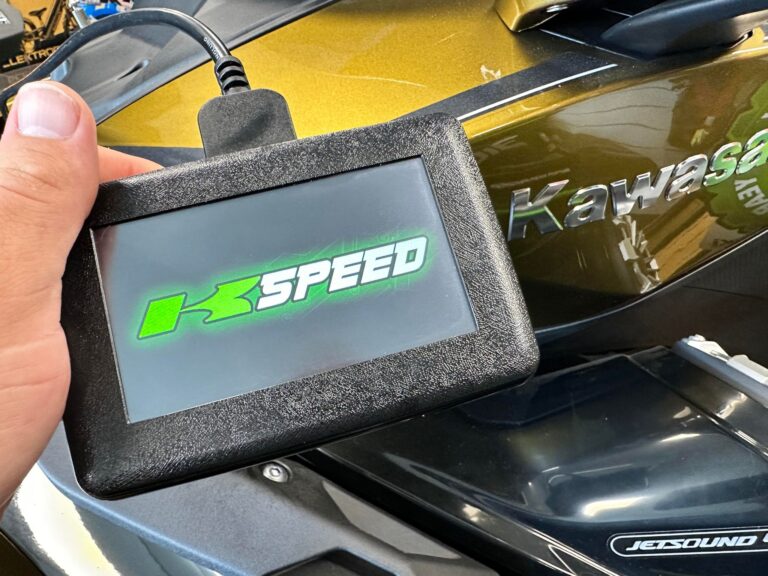
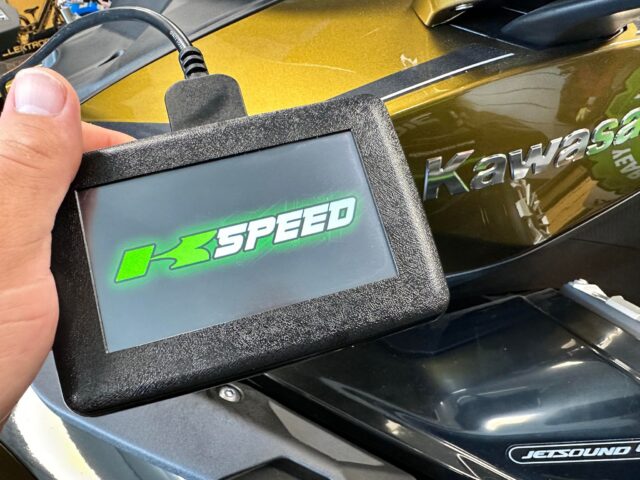
Video: Kspeed Shows How to Easily Deactivate Your Ultra’s Off-Throttle Steering

0

It’s a bit of a “no brainer” for those of us with experience that a personal watercraft cannot go if there’s no thrust pushing out of the nozzle; but to the neophyte the idea of applying throttle when trying to avoid an obstacle or collision can be counter intuitive to say the least. That was the thinking behind Kawasaki’s automated Off-Throttle Steering (OTS) system.

This feature has the tendency to catch some riders by surprise. As they quickly release the throttle, the ECU will apply a little extra thrust to keep the JetSki in motion. Of course, a sharp-and-short blip of the throttle will deactivate this, but again, this tip is for the newcomers. Nevertheless, the OTS activates to help the rider steer clear of an obstacle and you cannot steer without thrust.

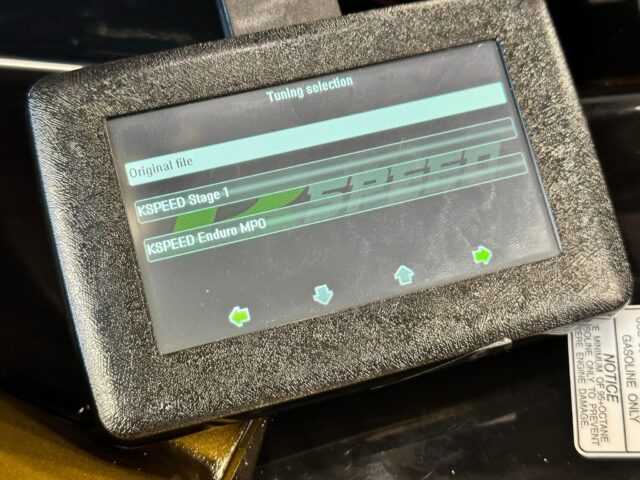
So what are you supposed to do if you’re a more experienced rider and do not want OTS kicking on every time you chop the throttle, there’s a very easy and non-invasive way to deactivate it without your ECU throwing a code – and the Kawi gurus at Brisbane Kawasaki and Kspeed put it all into a quick video posted to their Facebook page earlier this week. Watch: