
Home Blog Page 344

Video: Santa Can ‘Doo on a New 2016 Sea-Doo RXT-X 300

0

santa 2

Santa didn’t need any reindeer to pull the sleek 2016 Sea-Doo RXT-X 300. He had a shiny new red and black machine with a 300 horsepower engine. Recently, Sea-Doo posted a video on Facebook showing Santa unlocking the door to his stable where his new sled was located. He stared at it in amazement, rubbing his gloved hands over it as it underwent detailing by a couple of frantic Sea-Doo elves. Next thing you know, the two elves pulled the trailered craft to the dock where Santa promptly mounted it and got underway with a big red bag of goodies, reindeer completely out of his mind. He went nuts on that machine, doing cutbacks, throwing huge spray, and opening that baby up, only slowing down to drop presents on all the docks.

The red hot 3-seater with the new and improved Rotax 1630 ACE engine was built for a big man like Santa. The ergonomic steering allowed him to handle the beast in comfort and the machine was built for someone in a race who needed their feet comfortably wedged in the angled footwells. It was if this ski was built for Santa Claus to fly to all the docks along the waterway, no matter how rough the waters were. This personal watercraft was built to get Santa where he needed to go. The machine weighs in at just over 900 pounds (without all the goodies Santa was packing). And yes, Santa wears a PFD while pushing the limits on the new Sea-Doo RXT-X 300.

We Announce The Watercraft Journal 2015 Watercraft of The Year

0

PWCYEAR2015v.2

This model year welcomed many machines that were both radical improvements on previous vehicles, as well as completely new designs. That, and carry-overs from previous model years had us weighing lasting impact, appeal and longevity against the new and untested units. Thankfully, the industry hasn’t been stronger in nearly a decade, with domestic and international sales up into the double digits.

This has not only benefited the OEMs, but dealers and the performance aftermarket as well. In fact, we deferred much to the impact of two of the units listed – our Watercraft of The Year and our two runners-up – in making this year’s decision, as both craft played heavily on both new vehicle sales as well as in the aftermarket. You can see the runners-up here.

2015 Watercraft of The Year Winner: 2015 Yamaha FX Super Vortex High Output WaveRunner

oct1

Although it worked out to have all-three manufacturers represented on the podium this year, that was not our original intent. But, awarding the 2015 Yamaha FX SVHO WaveRunner the honor of The Watercraft Journal’s Watercraft of The Year award was almost a foregone conclusion the minute that Yamaha introduced the model with its new-for-2015 RiDE dual throttle system. The addition of the new brake and reverse system to its (near) entire lineup not only elevated the manufacturer to a whole new class of safety and rider input, but also gratefully replaced the right-hand reverse lever that we had beleaguered Yamaha over for years.

The current FX is a few years old, but the inclusion of both the new NanXcel2 lightweight bonding material and the Super Vortech High Output (SVHO) 1,812cc centrifugally supercharged 4-stroke to the three-seater in 2014 dramatically unveiled what many already knew: the FX hull is truly a fast and responsive design. But it wasn’t until Yamaha introduced us (and its 2015 lineup) to its new RiDE technology that it could ever be considered as Watercraft of The Year. Although additional features are found on the Cruiser edition, most of us found the high-backed stadium-style seating too restrictive for taller riders, and preferred the low-slung, stepped bench instead.

One of the biggest factors for the 2015 FX SVHO taking home this year’s Watercraft of The Year has been its recent surging presence in the racing scene, particularly in the realm of offshore and endurance competition. Although not near the rough water machine as the Ultra 310X, between the large diameter 160mm pump and sure-fire SVHO powerplant producing an unofficial 265 horsepower, the FX has proven itself as a true, full-tilt open class contender that can also be one of the most reliable long distance cruisers when equipped properly (ie. FX HO). There’s not a lot of hull designs that can boast such versatility.

And it’s that versatility that made the FX SVHO the choice over the closed-course darling FZR and FZS. It takes a level of athleticism to full engage the FZ models, and cruising such an aggressive hull is counter to its design. We recently documented the incredible numbers of the all but unchanged 2016 Yamaha FX SVHO WaveRunner when given the ideal conditions, and although very unlikely that most riders could replicate such speeds with a bone stock unit, the potential within this craft is seemingly limitless. Already, the aftermarket is awash in performance parts to maximize this 3-seater’s abilities, and we’re sure to only see more in the coming months. So with that, we want to congratulate Yamaha for earning this year’s The Watercraft Journal’s 2015 Watercraft of The Year!

We Announce The Watercraft Journal 2015 Watercraft of The Year

0

PWCYEAR2015v.2

In coming to a conclusion to last year’s far-from-unanimous decision to award the 2014 Sea-Doo Spark the “Watercraft of The Year,” we wondered if we had made the right decision. The craft among many diehard personal watercraft enthusiasts is controversial, and has been the recipient of a year’s long smear campaign by those who stump for competing brands, those who don’t understand it, and those who by no other fault have chosen to dislike it. The backlash caused us to defend the decision almost all year long, and as we did so, felt more and more secure in our verdict. Why? Because the Spark represented all of the traits we were weighing each candidate for: innovation, technology, attractiveness and ultimately, impact on the industry.

This model year welcomed many machines that were both radical improvements on previous vehicles, as well as completely new designs. That, and carry-overs from previous model years had us weighing lasting impact, appeal and longevity against the new and untested units. Thankfully, the industry hasn’t been stronger in nearly a decade, with domestic and international sales up into the double digits. This has not only benefited the OEMs, but dealers and the performance aftermarket as well. In fact, we deferred much to the impact of two of the units listed – our Watercraft of The Year and our two runners-up – in making this year’s decision, as both craft played heavily on both new vehicle sales as well as in the aftermarket.

2015 Watercraft of The Year Runner-Up: 2015 Kawasaki Ultra 310X SE JetSki

310-650x433

You’ll notice that for 2015, we actually share the “Runner-Up” position with another unit. When we tallied up the points for our Watercraft of The Year position, we found that although the 2015 Kawasaki Ultra 310X SE (Special Edition) JetSki came in two points behind our second place finisher, the machine itself is so impressive that we saw no fault in adding an additional spot in the article. Admittedly, the standard 310X was originally listed as the possible candidate, but in later review, we found enough reason to replace the 310X with its slightly more flashy SE sibling.

The Special Edition is only slightly different from the other supercharged Ultras, specifically by employing the 310R’s narrowed tear-shaped saddle but retaining its 5-point padded steering head. That, and its Burnt Orange hue are its only distinguishing traits. So in awarding the 310X SE, we, in a way, are awarding the 310X in the same breath. Admittedly, the 2015 Ultra 310X SE is unchanged from its 2014 predecessor (save for the metallic orange livery, which we absolutely applaud), but comes after years of fine-tuning an already impressive package.

In the realm of offshore racing, there is no undisputed king other than the Ultra 310X (and the SE). Its hull design is born from some of the roughest, most unmanageable riding conditions in North America. For which, the Eaton TVS-blown 1,496cc Kawasakis have claimed more offshore and endurance championships than any other four-stroke in the last decade. With the addition of better internal engine temperature management, electronic trim, cruise control, no wake modes and Eco settings, the Ultras have also stepped a little closer towards the high tech offerings from Sea-Doo and Yamaha.

Lastly, it’s worth defending the Kawasakis as they tend to get a bad rap as being “too heavy.” Such is simply not the case; Kawasaki lists their weights with full oil capacity and with their tanks 90-percent full of fuel. Seeing that the Ultras are rated at a maximum 20.6 gallons, that 90-percentile figures to 18.54 gallons of fuel. Calculated by 8.33 lbs. per gallon, that comes to 154.4 lbs. of fuel, and when subtracted from the listed “curb weight” of 1,040.8 lbs., it totals a dry weight of 892.9 lbs. Thereby making the Kawi less than 60 lbs. heavier than the 2015 FX SVHO, and 23 lbs. lighter than the 2016 RXT-X 300.

2015 Watercraft of The Year Runner-Up: 2015 Sea-Doo GTI 155 SE

61

When news first broke of the 2105 Sea-Doo color palette, many enthusiasts bristled at the new iridescent hues. Frankly, we were taken aback a little until feedback came in saying how much women preferred the new colors, particularly the Maldives Blue featured prominently on the 2015 GTI 155 SE. Although the GTI 155 SE didn’t debut any new technology for 2015 (apart from an improved DESS key for easier starts), it earned a strong second place in our points running for the 2015 Watercraft of The Year due to its balance of comfort, storage, performance and budget-friendliness.

To those regular readers of The Watercraft Journal, they’ll know the GTI 155 SE has been a perennial favorite, as it touts some of the best ergonomics of a medium-sized, family runabout. That, and with features like Sea-Doo’s iTC (Intelligent Throttle Control) that allows drivers to toggle through pre-programmed Touring, Sport and Eco modes without ever having to divert your attention from the vista in front of you, makes it a class leader. Bow and glove box storage is substantial, the saddle is narrow and bolstered, a thickly-padded swimstep comes standard, and the reliability of a 1503 Rotax 3-cylinder beneath the seat makes it a winner.

Although the SE doesn’t offer the rip-snortin’ horsepower of the larger RXT-X 260, it does share the same deck as the track-worthy RXP-X and hull of the 215-horsepower GTR. In Sport mode, the GTI is no slouch and will definitely leave you and your passengers with broad smiles. Draining the tank and jettisoning our camera equipment got our SE to nearly 60mph. And scrolling through the in dash settings permitted adjustment of the VTS (Variable Trim System), as well as other settings to the center LCD screen. And its naturally-aspirated Rotax permits using cheapo 87 octane, helping shave a few pennies from your day on the water too.

All-in-all, the GTI 155 SE is easily one of the best, most well-balanced family watercraft we’ve had the pleasure of reviewing, and even as we hunkered down one test unit with a few extra hundred pounds and tried to set a world record with it (that’s right! We used a 2015 Sea-Doo GTI 155 SE on our “Long Haul” cross-state attempt earlier this year), we still couldn’t help but think how much we’d like this machine to take the kids around the lake with.

2015 Watercraft of The Year Winner: 2015 Yamaha FX Super Vortex High Output WaveRunner

oct1

Although it worked out to have all-three manufacturers represented on the podium this year, that was not our original intent. But, awarding the 2015 Yamaha FX SVHO WaveRunner the honor of The Watercraft Journal’s Watercraft of The Year award was almost a foregone conclusion the minute that Yamaha introduced the model with its new-for-2015 RiDE dual throttle system. The addition of the new brake and reverse system to its (near) entire lineup not only elevated the manufacturer to a whole new class of safety and rider input, but also gratefully replaced the right-hand reverse lever that we had beleaguered Yamaha over for years.

The current FX is a few years old, but the inclusion of both the new NanXcel2 lightweight bonding material and the Super Vortech High Output (SVHO) 1,812cc centrifugally supercharged 4-stroke to the three-seater in 2014 dramatically unveiled what many already knew: the FX hull is truly a fast and responsive design. But it wasn’t until Yamaha introduced us (and its 2015 lineup) to its new RiDE technology that it could ever be considered as Watercraft of The Year. Although additional features are found on the Cruiser edition, most of us found the high-backed stadium-style seating too restrictive for taller riders, and preferred the low-slung, stepped bench instead.

One of the biggest factors for the 2015 FX SVHO taking home this year’s Watercraft of The Year has been its recent surging presence in the racing scene, particularly in the realm of offshore and endurance competition. Although not near the rough water machine as the Ultra 310X, between the large diameter 160mm pump and sure-fire SVHO powerplant producing an unofficial 265 horsepower, the FX has proven itself as a true, full-tilt open class contender that can also be one of the most reliable long distance cruisers when equipped properly (ie. FX HO). There’s not a lot of hull designs that can boast such versatility.

And it’s that versatility that made the FX SVHO the choice over the closed-course darling FZR and FZS. It takes a level of athleticism to full engage the FZ models, and cruising such an aggressive hull is counter to its design. We recently documented the incredible numbers of the all but unchanged 2016 Yamaha FX SVHO WaveRunner when given the ideal conditions, and although very unlikely that most riders could replicate such speeds with a bone stock unit, the potential within this craft is seemingly limitless. Already, the aftermarket is awash in performance parts to maximize this 3-seater’s abilities, and we’re sure to only see more in the coming months. So with that, we want to congratulate Yamaha for earning this year’s The Watercraft Journal’s 2015 Watercraft of The Year!

(Video) NOLA PWC Fort Tour – Part II

0

FORT

[Welcome to the next chapter in my ongoing pursuit of recording New Orleans military history by PWC; a random journey across water and time that began here. – Billy Crews]

This was not an easy ride and certainly not a route configuration I would have conceived. But am I glad I went? Absolutely! Thank you Axel and Michael for letting me join your small armada for launching yet another amphibious assault on a selection of NOLA Forts.

20151206_083311
Departing from Empire, LA.

We had an early start, arriving at the Delta Marina in Empire, LA, about 65 miles below NOLA (New Orleans, LA). Engaging a local fisherman pre-launch, he noted our skis and I offered up our plan: A quick out and back trip down river to see Forts Jackson and St. Phillip, each on opposite sides of the river. Then a decision, based on wind and seas, to travel to Fort Livingston on West Grand Terre Island.

The feedback was positive: The river was no problem. Fort Livingston? The outside leg to Grand Terre is shorter, but the seas could make it rough. If we traveled on the inside – across Barataria Bay – the trip would be longer but more protected. And we could also run the risk of running aground in shallow waters or oyster reefs.

P1240254
Axel studies a gun base along Ft. Jackson’s terraplein.

We launched and immediately locked through to the Mississippi River and proceeded down river. The water was mild and the traffic light. Our first leg was ten miles and we soon arrived at Fort Jackson. While the fort had origins dating back to 1793, the current design is from 1822. We hiked the large brick fort, inspected numerous features and recorded the area with our cameras.

Crossing over, we headed for the east bank. Unlike the west bank, there is no levee on this side of the river. The river is breaking through the marsh at this point, and the bayou, at nearly a foot lower than the river stage, had fast a moving current with large whirlpools here and there. We let the skis drift in the current and out of the river using the throttle to navigate around fast moving eddies. Next, we found the small ditch that accessed the rear of the property and a few minutes later had arrived at Fort St. Phillip.

20151206_100511_001
Navigating Ft. St. Phillip’s rear moat.

Despite the ease with which it can be reached, Fort St. Phillip was the highlight of the trip. The site’s origins date back to colonial Spanish Louisiana and had been expanded upon for well over 100 years. The entire site has fallen victim to neglect and the forces of nature: What hasn’t been destroyed by storms and flooding is quietly sinking into the marsh. At over half a mile long, the fort’s area is huge and one could spend an entire day doing nothing but inspecting the various bunkers and batteries. We allotted ourselves one hour and did what we could with the time at hand.

Back on the skis, we routed back north, locked out of the river, and arrived back at the starting point. Mike and I each topped-off the Doos; Axel declined as he had 5 gallons riding on the back and still had plenty on the internal tank of his naturally-aspirated Yamaha. Axel checked his beta and reported a one-to-two foot swell eight seconds apart. We decided that was flat enough and Axel led the trio due south to the Empire Jetty.

P1240269
A concrete bunker of Ft. St. Phillip slowly sinks into the marsh.

Two miles down the run, Axel, for some reason ran off the center line. Consulting my Garmin GPSmap 76CS, I stayed put and Michael joined me. Axel finally came back, pointed at his GPS and once again went on point. A few miles later, the jetty came into view and the Gulf of Mexico (GoM) just beyond. It was at this point Axel went wide right, off the center line again.

According to my GPS, despite all the water within site, Axel was traveling across land. I stuck to the marked route I had plotted on my ’76, Michael followed, and a few minutes later we had lost Axel on the horizon. He had never looked back to notice we weren’t following any more. He eventually stopped, found us in the open water, and reported a GPS glitch. No worries – our target was due west, I was locked on the route, and west we went.

P1240316
Granite lentels and solid brick walls show what remains of Fort Livingston.

The buoy data reported a correct swell; what it didn’t report was the one-to-two foot white caps on top of and in between every crest. The further west we traveled the worse it became. At exactly twelve miles – and half of the twenty-four mile open water crossing we had to make – Mike’s ski (my loaner) threw a “Check Engine” error code. It could have not happened in worse place, naturally. Mike killed the ski, cranked it over, and the code cleared. I told him keep going and don’t stop ’till it stops. Further west we went and still no relief.

What started as a “let’s go see how bad it is” turned into “we can’t turn back now, we’re over halfway.” West Grand Terre, Fort Livingston, and the populated Grand Isle finally came into view. And the seas got a little more rough. Before finding the calm water behind the island, we all took waves over the handlebars and got a face full of cold, salty water. “OK,” I grumbled. “I’m really not having fun now…”

P1240323
Parked and waiting at West Grand Terre Island.

We idled around the back of the fort, near the moat, where the water was shallow but firm on bottom. We anchored the skis and hiked across the water and accessed Fort Livingston via the collapsing rear outer wall. What was once going to be another great brick fort was never completed. Now, unattended or maintained by the state, Fort Livingston is slowly being repossessed by the GoM. We quickly inspected the fort inside and out, recorded the moment and hastily fled the bug-infested island. All three of us had a terrible time fending off swarms of mosquitoes and I shudder to think what life must have been like for members of the garrison.

It was decision time: The sun was on it’s way to finishing its arc across the sky and we had a possibility of a ski going down. We would go back on the inside across Barataria Bay. We decided the seas couldn’t be much worse and, in the event of a breakdown and losing sunlight, we could find shelter on one of the numerous O&G rigs. Mike and I crossed the channel to Grand Isle and made a quick top-off at the Sand Dollar Marina. We had left Axel behind as he dumped his five gallon jerry can. Meeting back out in the channel, I took the point and across Barataria Bay we went.

P1240325
Three amigos L to R: Axel, Billy, and Michael.

Our first leg was due north and for the most part we ran nearly parallel with the one-foot chop. But after eleven miles the chop became a real nuisance. We finally made the northern terminus and I swung due east, following the lines on my ’76. Our next leg was more or less dead into a fifteen knot wind and every whitecap it brought with it. I would occasionally look over my shoulder and with every glance I found Michael and Axel dead in my wake. We were mindful of the possibilities of shallow water – there was no sense in being three wide when one could make the mistake for the other two. Fourteen miles and two sore kidneys later, we had finally crossed the big, bad, Barataria without incident.

Once we gained Grand Bayou and its ever so smooth glass water, I came to a halt and motioned Mike and Axel over. I had a request: When we get back to the marina, please beat me good – I don’t want to leave here thinking I had not been beat bad enough! Suffice it to say, the twenty-five miles of bay crossing on top of the GoM stretch had taken its toll on me. I think it’s safe to say we all felt the same.

20151206_163505
A full day of PWC work in the month of December.

Travelling south in Grand Bayou, we eventually found Adams Bay and navigated according to the white PVC pipes marking the edges of the oyster reefs. And there are square miles of oyster reefs – where the white pipes are your friends and should be well minded. When we arrived at the marina, it was near 4:30PM and we had completed a 102 mile trek. We had a just enough sunlight left to take care of trailering the skis and preparing everything for our individual long rides home – to more central Louisiana, to south Mississippi, and to the panhandle of Florida.

Was this a great ride? The fact that three riders came from three states in the month of December says it all. Will I do this ride again? Hmm… I’ll have to get back with you on that one.

“NOLA PWC Fort Tour – Part II” Trip Report by Billy Crews. Pictures and videos by Billy, Michael, & Axel. Post production video: a Barrier Island production by Michael King

Video: Athletes In Motion Sports TV Recaps 2015 Blowsion Surf Slam

0

11046199_664760206983513_2021792487796851514_n

“If only jet skiing was covered like a television show.” It’s something we’ve all thought, said or have heard, and when looking at some of the crap that does actually make it onto the small screen, it’s almost embarrassing that our sport gets passed up. Well thankfully, with events like the Pro Watercross World Championships being televised by CBS Sports nationwide (and beyond) and AquaX receiving local Fox Sports syndicate coverage, dreams of jet skiing returning to regular programming (like it once did on ESPN decades ago), are becoming ever closer to a reality.

Yesterday, a near-30 minute recap of last September’s 2015 Blowsion Surf Slam was published by Athletes In Motion Sports Television (aimsports.tv), who was on-hand in Pacific City, Oregon, as a presenting media partner for the 2015 Blowsion Surf Slam, and edited together some awesome aerial and surf slashing footage from the Pacific Coast event. According to Athletes In Motor Sports TV, “This incredible event drew the largest field of competitors and spectators in its history that came from all over the world to see one of the fastest growing action sports on the planet. Paul J. Higgins and his AIMSports TV production crew bring you all the great action.”

Of course, The Watercraft Journal was present and accounted for, providing the fastest coverage and full photo gallery from the Surf Slam, which was published days after the event closed (as per usual). Yet, this footage really captures the spirit of the event and is frankly a great little reminder of why we do what we do when the weather turns to crap. Enjoy!

AquaX Announces Ambitious Schedule for 2016

1

471-650x433

AquaX, the rapidly growing stock PWC racing series, will be undergoing some changes for 2016. These changes should bring even more new riders and fans to the sport! AquaX released their ambitious plans for 2016, including the dividing of riders into Amateur and Pro level competition. They feel this move will give some up and coming riders a chance to grow in the sport before they step up and take on the pros. Also, as you may have already heard, they have arranged for an additional championship in the Great Lakes region. Along with that, they have announced a completely new race style for sport and ski classes.

The AquaX staff has decided that while the wide open courses best suit the larger, faster runabouts produced today, the closed course racing form best suits the Sport and Ski riders. They will be holding both Enduro events, which are the traditional AquaX course format for the full sized runabouts, as well as Sprint events, which will be closed course races for the sport and ski classes. The Sprint events will follow IJSBA closed course class technical rules of both Sport Stock and Sport GP.

Initially, the Sea-Doo Spark will be eligible for Sport class competition to attract new racers, but may be split into its own class once it grows some. The ski category will be split into Junior, Amateur, and Pro classes, to provide a more natural “stepping stone” into Pro class.

Along with the racing series in Florida, there will be a three round Enduro series in the Great Lakes region, as well as the IJSBA National Championships being held in Chicago. This will also promote growth of the AquaX series by giving racers from the Midwest and New England area a chance to compete. There will also be an Amateur Enduro series for runabout racers who are not quite on the Pro level just yet. This will give racers a chance to enter the sport without having to compete against the top riders in the series. We think this will be a more welcoming environment for new racers, and will give them a chance to take home some hardware as well.

Here’s how the tentative 2016 AquaX schedule looks:
AquaX Amateur Enduro Florida Championships
RD1 – 9th April Tavares, FL –
RD2 – 23rd-24th April Daytona, FL
RD3 – 21st May Kissimmee, FL
RD4 – 2nd-3rd July Sarasota, FL

AquaX Pro Enduro Championships
RD1 – 23rd-24th April Daytona, FL
RD2 – 2nd-3rd July Sarasota, FL
RD3 – 10th-11th Sept Chicago, IL
RD4 – 29th-30th Oct Cocoa Beach, FL
RD5 – 12th-13th Nov Palm Beach, FL
RD6 – 19th-20th Nov Fort Lauderdale, FL

AquaX Sprint Atlantic Championships
RD1 – 23rd-24th April Daytona, FL
RD2 – 29th-30th Oct Cocoa Beach, FL
RD3 – 12th-13th Nov Palm Beach, FL
RD4 – 19th-20th Nov Fort Lauderdale, FL

AquaX Amateur Enduro Great Lakes Championships
RD1 – TBD
RD2 – 6th-7th August Whiting, IN
RD3 – 10th-11th Sept Chicago, IL

IJSBA National Championships
9/10-11 – Sept Chicago, IL

*some dates are still to be confirmed. You can find more info on the AquaX race series and their schedule for 2016 here.

The Watercraft Journal’s 2015 Top 10 Christmas Gifts For Jet Skiers

0
DCIM100GOPRO

XMAS

It’s hard to narrow down what could very well be perceived as our favorite products that we’ve reviewed this year. With thousands of dollars worth of awesome and innovative items on hand, we weighed each item for its added value or convenience, functionality and ease of use, and of course, price. So while you are getting in your last minute shopping for your friends and loved ones, take a minute and look over this list with the avid jet skier in your life (and it might just be you), and see if any of these would make a great gift for the holiday season!

313-650x433

1. Kool PWC Stuff Jet Ski Fishing/Cooler Rack – $390
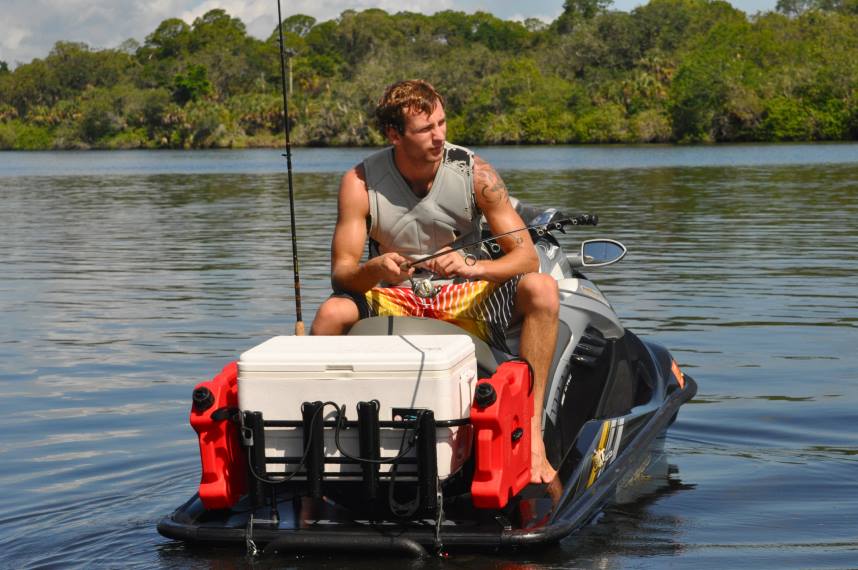
There’s a reason we list Kool PWC Stuff’s Fishing/Cooler Rack for a second year in a row, it’s easily one of the best items we’ve had the pleasure of testing. So much so, that we couldn’t have attempted this summer’s “Long Haul” record without the use of this easy-to-install, non-invasive storage rack system, which we used to tote over 22 gallons of extra fuel through a pair of 5 gallon cans in the large center section, and an impressive 12 gallons in four Rotopax mounted to its sides, held on by an innovative billet aluminum bracket system.

Now, we only used the Kool PWC Stuff rack for a portion of its true intent, as the sturdy stainless steel and powder coated rack isn’t called a Jet Ski Fishing/Cooler Rack for nothing. Available through Kool PWC Stuff’s webstore are a myriad of options to outfit your rack the way you want, whether for cruising the lake with some added fuel and a big cooler, or trawling the kelp beds with a life bait tank and a quartet of rod holders. No matter how you cut it, the zero cutting, zero drilling Kool PWC Stuff rack is one of our favorites and is sure to be one of yours too!

fin1-650x366

2. Blacktip JetSports’ Elite Seat Covers – Various
With patterns and designs for nearly every imaginable seat configuration on hand, Blacktip JetSports’ line of Elite seat covers not only can rejuvenate your runabout’s faded and/or cracked and peeling seat cover, but can provide added traction, comfort and flair to an otherwise bland bench seat. Every seat cover is specifically designed to your watercraft’s bolstering, shape and coloring, so you have a cover that not only matches the look, but feel of your PWC.

Placed through The Watercraft Superstore, ordering your Blacktip JetSports Elite seat cover is simple and painless. And don’t fear the installation either, as replacing your seat cover is made easy with just a few hand tools (as shown on The Watercraft Journal earlier this year). Best of all, Blacktip promises a lightning fast turnaround from the time of ordering to the date of shipping (in most cases, 2-to-3 days!), significantly faster than competing seat cover makers.

410-650x433

3. RIVA Racing/Vi-Pec V88R3 Pro-Series ECU – $2399.95
For the top-of-the-line performance enthusiast, there is only one solution to unlocking the full potential of their supercharged 4-stroke Yamaha or Sea-Doo, and that’s the RIVA Racing/Vi-Pec V88R3 Pro-Series Engine Control Unit (ECU). The control module offers much more than just removing any speed limiting features imbued in the craft’s factory programming, but extensive Vi-PEC data logging, easy-to-load calibration maps for a variety of performance levels (with updates supplied through RIVA’s ECU website), optimized fuel mapping, timing curves, boost control and a rev limiter increase.

There’s also added safety features like diagnostic info, air/fuel mixture data, a knock sensor. And while a majority of Vi-Pec users will be content to use RIVA’s supplied maps and curve data (all extensively tested both on the water and in RIVA’s own dyno cell), the supplied software that comes with V88R3 allows for customization to fuel, timing, the rev limiter and boost control, all with retaining the OEM dash display, engine diagnostic and engine safety functions – including use of the Sea-Doo’s iBR system.

IMG_5301-EDITED-650x433

4. IPD Graphic’s Yamaha Squarenose SuperJet Graphics Kit (NS Design) – $299
What is old is new again. In the past few years, there’s been a resurgence in popularity in standup skis, particularly with teenagers and those in their early-to-mid 20’s. In fact, standup sales are estimated to be in the thousands for 2015, but seeing that tracking Craigslist and other private sales is almost entirely impossible, we’ve had to gauge this resurgence in the growth of sales for vintage 2-stroke ski parts, equipment and accessories.

That being said, we were stoked to document how easily a “Craigslist find” Squarenose can be made new again just with a decent cleanup and a new set of vinyl decals. IPD Graphic’s new Yamaha SuperJet kits can do exactly that, and make a cheapo 20-year-old ski look sharp as new with just a Saturday afternoon’s worth of work. Through IPD’s detailed website, you can customize the color, design and overall aesthetic of your graphics kit to look just the way you like, including sponsorship logos, race numbers or even have your own name run alongside the tray.

217-650x433

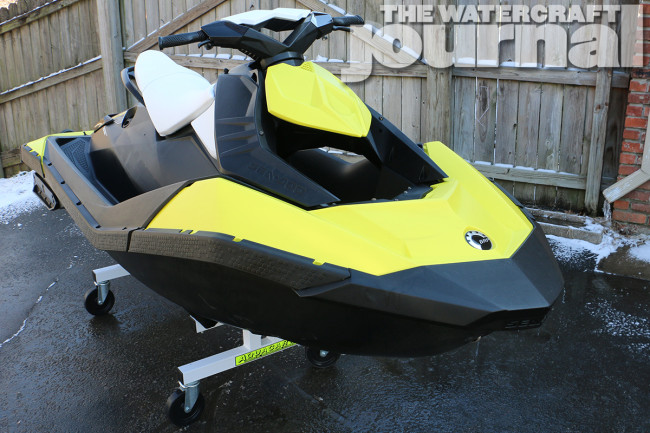
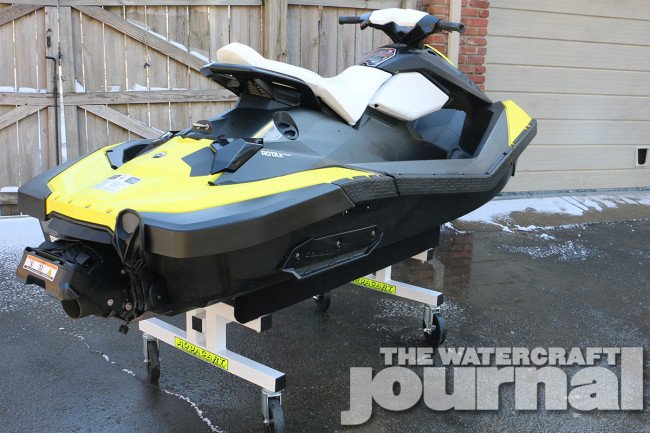
5. Aquacarts’ AQ-19 Cart & Service Stand – $234.95
OK, in all fairness, this is much of a “stocking stuffer,” but the Aquacart AQ-19 Cart & Service Stand has easily become one of the single-most important tools in our shop. In fact, if you ever intend to do any work on your personal watercraft, be it an oil change or pulling the engine, you’re going to need one of these for your shop or home garage. Built to handle anything between a featherweight Yamaha SuperJet or a hulking Sea-Doo GTX iS Limited, its 1,400-pound weight capacity can take it all.

Built from heavy-duty 2-inch 14-gauge steel square tubing, and powder coated bright white, the AQ-19 rolls on four-axis, locking 5-inch diameter swivel casters that roll smoothly across polished or coated concrete or cracked and porous asphalt with no problem. We’ve come to love our Aquacart and there’s no way that we’re giving it back. After you’ve gotten yours, you’ll feel the exact same way.

66-650x433

6. Airhead Dry Pak Camera/Smart Phone Case – $19.99
If you’re like us, you’re umbilically tethered to your cell phone. Not only is it our primary source of communication with the outside world, but its also our camera, photo and music library, contact Rolodex, and entertainment center. Once Apple figures out how to get an iPhone to feed and bath us, it will be almost the only thing we’ll ever need. So naturally, we bring our smart phones with us when we ride and that’s why keeping it safe and dry is so important. That’s why we recommend Airhead’s Dry Pak Camera and Smart Phone cases.

We were able to review the Dry Pak Camera Case earlier this year and continue to use it even after we switched from a UAG impact case to a waterproof Lifeproof case. The sealable pouch is made with a thick optically clear TPU that allows you to navigate your phone’s screen even while in the pouch and wearing gloves! Available in a variety of sizes, our 6-inch wide x 5 inch long x 2 inch deep case not only accommodated our phone, but our car’s electronic key fob and wallet as well.

210

7. Jobe Watersports’ Youth Progress Neo Vest – $115
Our days on the lake tend to be more family-oriented than time spent on the shoreline razzing our buddies as they fumbled trying to lean-in and cut a buoy. With the median PWC buyer in their mid-forties, many are in the proverbial same boat. That’s why Jobe’s Youth Progress Neo Vest kept creeping back up our list for this year. Although much pricier than most kid’s vests, the Youth Progress Neo vest is specifically designed for your little ones, and goes on and off easily thanks to a big thick front zipper and dual buckle. Made with soft neoprene and PVC foam, it won’t rub or scratch your kids’ soft skin either, which should keep the complaining to a minimum. Yeah, we know. You’re welcome.

119-650x433

8. EZ Throttle Sea-Doo iTC Throttle Extension – $19.99
Another returning favorite to our annual list is the EZ Throttle Sea-Doo iTC Throttle Extension. This EZ Throttle is made specifically for the Sea-Doo models (2009-and-up) using BRP’s class-leading Intelligent Throttle Control system (iBR). Because of the sensitivity of the fly-by-wire trigger system, the EZ Throttle attaches to the factory throttle different from that of say, a Yamaha WaveRunner. The EZ Throttle was also used during this summer’s “Long Haul” attempt and proved itself incredibly useful in keeping our hands comfortable and from cramping over long periods of riding. For the long distance rider or those who suffer from fatigue, the EZ Throttle continues to be one of The Watercraft Journal’s top items.

Screen Shot 2015-12-16 at 11.18.18 AM

9. Thrust Innovations’ Billet Adjustable Hood Latch – $84.95
There’s a level of craftsmanship seen on freestyle and freeride skis that simply isn’t found anywhere else in modified performance watercraft. Even the 100mph HydroDrag racers’ runabouts aren’t swinging this much bling. And a major contributor to these aquatic acrobats looking so good is Thrust Innovations. We recently checked out Thrust’s new Billet Adjustable Hood Latches. The very first adjustable hood latch on the market, adjusting the tension on your standup’s hood is as easy as loosing and tightening one bolt. The patent-pending design is made from CNC machined 6061 aluminum and can be had in one of five colors.

191-650x433

10. Gibbs Quadski XL – $50,000
If you thought the Aquacart was “a little much” for our list, then you’re gonna love the Gibbs Quadski XL. The Watercraft Journal was the first PWC publication to review this massive watercraft/quad hybrid and were impressed at the technology imbued into this machine. Standing 53-inches tall with over eight-and-a-half inches of ground clearance, the massive 140.2-inch long two-seater ATV/runabout is a full 12-inches longer than its one-seater sibling,  and is 62.5-inches wide.

On land, the XL is shifted through a sequential, electronically-controlled gearbox with a centrifugal clutch (with an electronically-operated land reverse gear), and propelled on water by a proprietary lightweight jet drive pushing thrust through an 11-vane stator via a stainless steel 5-blade impeller. Powered by a BMW 140-horsepower K1300 (1293cc) water-cooled 4-stroke in-line 4-cylinder, the Quadski maxes at 45mph, be it on land or at sea. Transitioning between land and sea modes is slow, and the craft is not the most nimble in either configurations, but is the only machine to do either adequately well.

RIVA Racing’s Power Filter For Sea-Doo Sparks

3

F141263563

There has been very few models of personal watercraft to have made such an impact both on the sport and the industry as Sea-Doo’s Spark. The lightweight, athletic runabout has personally accounted for no less than a 10-percent increase in total unit sales in 2015 alone, and has, according to certain sources, single-handedly eclipsed the total market share of Kawasaki alone. With a purported 48 different configurations, the Spark is quickly becoming a force to be reckoned with.

As demand for the nimble two- and three-seaters continues, so does the demand for greater performance. With that comes RIVA Racing, and it’s new Power Filter. This cold air element feeds the Spark’s engine with a steady supply of cool, dense air delivering significant gains to both throttle response and overall power. The intake duct has been precision-formed to channel outside ambient air from original hull vents to the OEM airbox. There, the cool air is pulled into the ACE 900’s throttle body through a industry-leading K&N filter element.

The molded air duct not only provides the engine a greater volume of air, but also at an increased velocity, acting as a “ram induction” inlet. This, of course adds greatly to the ACE motor’s efficiency, delivering added power and acceleration. Designed as a direct replacement to the factory air induction system, the RIVA Racing Power Filter installs quickly and easily with the included instructions. And priced at $215, it’s the easiest (and most affordable) horsepower you can bolt onto your Spark.

Real Review: Fly Racing F2 Carbon Dubstep Helmet

0

DUB1

When you think Fly Racing, you probably think of the motocross racers, sporting Fly gear from head to toe. That’s understandable, as Fly is a prominent figure in the motocross world, selling a wide range of top-notch gear for the riders on two wheels. Don’t be mislead, though. They do have plenty of gear for other extreme sports as well, including PWC racing.

Thanks to Fly Racing, we were able to get our hands on their top of the line F2 Carbon Dubstep helmet, designed with watersports in mind. When we first received the helmet, we noticed it was considerably lighter than other competitors’ helmets we’ve tried. This is mostly due to it’s durable, yet extremely light shell, constructed with state-of-the-art aircraft grade woven carbon fiber and Kevlar composite. It is also held together with lightweight aluminum screws and rivets, which also cuts down on weight and stands up to even the toughest conditions watercraft racing has to offer.

2

It’s not hard to tell that Fly Racing has put a lot of effort into making this helmet as racer friendly as possible. When you’re out there on the race course, midway through a moto, the last thing you want is for your head to be baking inside your helmet. Some helmets are designed with as little as two intake and exhaust vents, which doesn’t properly allow air to flow through. Fly racing has equipped the F2 series helmets with eleven intake and four exhaust vents, which kept us plenty cool when out on the water. As if the fifteen air vents aren’t enough, the inside of the helmet is also designed with COOLMAX comfort liner and cheek pads, which as well as protecting you, it helps with the ventilation and absorbs sweat.

Also, a common problem with helmets and goggles is the goggles fogging up. This can obstruct your vision, which can put the rider in a dangerous situation, especially if you’re fighting for position or surrounded by other riders. The F2 helmets are designed with four vents above the goggle eye port to draw air away from the goggles, thus helping prevent them from fogging up. This doesn’t necessarily mean your goggles can’t fog up, it just makes them less likely to.

Thankfully, we didn’t have to rely on this helmet to protect us in an impact. We are confident, though, that if we did, it would have protected us sufficiently. With a durable shell that is sure to be among the strongest on the market, dual density EPS (Expanded Polystyrene) liner to provide more progressive impact absorption, and the COOLMAX cheek pads provide plenty of cushion to protect you in a collision as well as making this one comfortable helmet. This helmet met or exceeded all of the toughest safety standards on the market.

So it’s got some cool features and a lot of engineering work in it, but how does it fair in real world use? In a closed course racing environment, we put it through the ultimate test, and think it passed with flying colors. Approaching the line for the first moto, we were curious to find out how the F2 Carbon helmet would perform. Our goggles did fog up while waiting at the line, but we believe that was just because the anti-fog vents can’t draw air when not in motion. After they were wiped clean and the race started, the issue never reoccurred.

20

The low weight of this helmet allowed for easy and quick movement of our head with no problem, which is crucial, especially when in technical sections of the course. The excessive number of ventilation slots and the COOLMAX liner kept us cool, comfortable, and complaint free throughout the entire race. Lining up for the next race, we had one final test to put it through. One we would’ve rather not tested during a race, but ended up doing it anyways. We went for a swim at 60-plus-mph, and it actually went better than we had anticipated. The helmet was very hydrodynamic, and didn’t jerk our head much at all.

Once back above the surface, it didn’t become waterlogged as we had expected. It may have held some water, but it didn’t become unbearably heavy. Overall, we were very impressed with this product and would recommend it to anyone looking for a top-tier helmet for any kind of racing or just aggressive recreational fun. You can find all the variations of the Fly Racing F2 Carbon helmets along with more info about them here. The F2 Carbon series helmets are all basically the same, just offered in different colors and styles. While they do come at a price of $399.95, we believe the quality of this helmet is well worth the extra coin.

20 1 21 9 8 7 6 5 4 2
<
>

Case of The Mondays: Yeehaw! The General Lee Seabreacher (Video)

0

12341222_1015128438529316_6467769147808514969_n

Earlier this year, in the wake of a terrible tragedy caused by a Ritalin-addled sociopath, the nanny-state sought to not address the status of our nation’s treatment of its mentally ill, but rather, to outlaw the last remaining remnant of southern identity, the Confederate Flag.

While this was a ridiculous reaction, what pushed it into the realm of sublimely moronic is the subsequent retaliation against of all things, a 30-year-old television serial, “The Dukes of Hazzard.” Y’know, the show about two fun-loving Georgian cousins who drive a tangerine ’69 Dodge Charger through the backwoods of the Los Angeles Mountains mascaraing as Georgia’s rolling hills.

Yup, ‘dem good ol’ boys got themselves in a heap o’ trouble with the swelling PC culture and there wasn’t much that CBS/Warner Brothers could do but outright outlaw any future merchandising of the eponymous “General Lee,” the single-most recognizable television/movie car in film history.

12376064_1015128448529315_5001762590560985839_n 12345390_1015128121862681_6442195467970381711_n 12376505_1015127881862705_3542747837769013589_n 12360178_1015128421862651_6276605358751008357_n 12316173_1015127671862726_4817442964561068625_n 12369130_1015127955196031_1207207211758655487_n 12316427_1015127788529381_2757588207757915601_n 12321123_1015127885196038_4485344713147899644_n 11215744_1015127755196051_5304291595824048879_n
<
>

Funny enough, the backlash was so strong, so over-the-top that sales of Confederate flags exploded, and demand for “General Lee” merchandise skyrocketed on eBay. Several of the show’s stars – including former Senator Ben Jones who played “Cooter Davenport” and the immortally handsome Jonathan Schneider, “Bo Duke” both spoke out against the ban calling it both moronic and depressing.

Thankfully, nobody is scrapping Generals (besides the ones jumped hundreds of feet at every annual “Dukes Fest”), and the Dodge Charger is just as famous as Daisy’s short shorts. So much so, that Seabreacher has even painted one of its porpoising watercraft as the famous orange stock car, making its aerial acrobatics even more appropriate.

While most of us have seen the Seabreacher in action before, and therefore are familiar with its agility, we do think making it honor “The Dukes” and their famous race car makes it all the more entertaining. Now if only there was room to store a few dozen mason jars of “white lightning” in the back…